
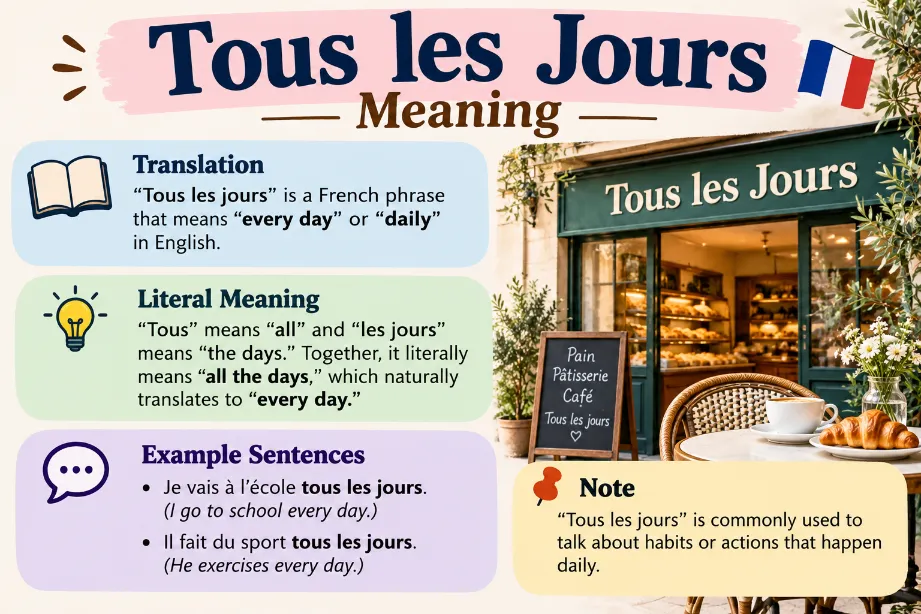
Tous les Jours is a French expression that means “every day” in English. The phrase describes an activity that happens daily or forms part of a regular routine. It can refer to daily habits, work schedules, meals, exercise, and ordinary activities.
The spelling in the keyword “Tous le Jours” needs a small correction. The standard French expression is “Tous les jours,” with les rather than le. French uses les for plural nouns, and jours means “days.”
| French term | English meaning |
|---|---|
| Tous les jours | Every day |
| Tous | All or every |
| Les | The (plural) |
| Jours | Days |
| Chaque jour | Each day |
The phrase expresses regularity. For example, someone who walks to work daily might say, “Je marche tous les jours,” meaning “I walk every day.”
The Correct French Spelling
The correct spelling is tous les jours. Although “tous le jours” may appear in searches or informal writing, it does not follow standard French grammar.
The reason is simple: jours is a masculine plural noun, so the phrase uses the plural article les. The word tous also takes its plural form to agree with the noun.
Here are a few examples to help distinguish the forms:
- Correct: Je travaille tous les jours. — I work every day.
- Correct: Il lit tous les jours. — He reads every day.
- Incorrect: Je travaille tous le jours.
- Incorrect: Je travaille tout les jours.
For everyday French writing, remember the pattern tous les + plural noun.
How to Pronounce Tous les Jours
The French phrase tous les jours sounds approximately like “too lay zhoor” to English speakers.
French pronunciation differs from English spelling. The final s in tous links to the following word, creating a soft “z” sound. The French j in jours sounds similar to the “s” in the English word “measure.”
A few pronunciation tips:
- Say the phrase smoothly rather than separating every word.
- Keep the French vowel sounds short and natural.
- Practice the phrase aloud alongside simple daily sentences.
Examples of Tous les Jours in French Sentences
The phrase fits naturally into conversations about habits, routines, and repeated actions. Here are some useful examples with English translations.
| French sentence | English translation |
|---|---|
| Je bois du café tous les jours. | I drink coffee every day. |
| Elle étudie tous les jours. | She studies every day. |
| Nous marchons tous les jours. | We walk every day. |
| Il cuisine tous les jours. | He cooks every day. |
| Je parle français tous les jours. | I speak French every day. |
| Ils vont à l’école tous les jours. | They go to school every day. |
These sentences show how the expression works with different verbs. It usually appears after the verb or at the beginning of a sentence for emphasis.
For example, “Tous les jours, je lis un livre” means “Every day, I read a book.”
Also Check: Quel Dommage Meaning
Tous les Jours Meaning in Everyday Conversations
French speakers use tous les jours to describe regular activities and daily routines. It works in casual conversations, written messages, and formal situations.
Common uses include:
- Daily routines: describing waking up, cooking, studying, or exercising.
- Work and school: talking about regular shifts, classes, or assignments.
- Personal habits: discussing reading, listening to music, or learning languages.
- Lifestyle: describing activities that form part of ordinary life.
For example, a person might say, “Je fais du sport tous les jours,” meaning “I exercise every day.”
The phrase communicates frequency rather than the duration of an activity. It tells the listener that something happens each day, rather than describing an activity that lasts for an entire day.
Tous les Jours Meaning as a Bakery Brand
TOUS les JOURS also serves as the name of a bakery and café brand that sells breads, pastries, cakes, desserts, and drinks.
The company uses the French phrase to express its focus on providing bakery products for everyday enjoyment. Its name translates to “every day” in French.
The brand combines French-inspired baking with Korean and other Asian influences. Its menu features items such as croissants, cream cakes, specialty breads, and handcrafted beverages.
The brand name carries a practical message: freshness and bakery products prepared for daily enjoyment.
Difference Between Tous les Jours and Chaque Jour
Both French expressions mean “every day” or “each day.” Their meanings overlap, although the emphasis may differ slightly depending on the sentence.
| Expression | English meaning | Typical use |
|---|---|---|
| Tous les jours | Every day | Regular habits and repeated activities |
| Chaque jour | Each day | Individual days or daily progression |
| Tous les matins | Every morning | Activities repeated each morning |
| Tous les soirs | Every evening | Evening routines |
| Tous les deux jours | Every two days | Activities occurring on alternate days |
For example:
- Je cours tous les jours. — I run every day.
- Chaque jour apporte une nouvelle expérience. — Each day brings a new experience.
Both expressions are grammatically correct. The best option depends on the sentence and the emphasis the speaker wants to convey.
Common Mistakes Related to Tous les Jours
French learners may confuse the spelling or meaning of this expression. A few simple rules help prevent errors.
- Writing “tous le jours”: Use tous les jours because jours is plural.
- Writing “tout les jours”: Use tous, not tout, before the plural noun.
- Translating word by word: Translate the complete expression as “every day,” rather than producing an unnatural English phrase.
- Confusing frequency with duration: Tous les jours means something happens daily; toute la journée means “all day.”
- Pronouncing every letter separately: French linking changes the sound of the phrase in natural speech.
These distinctions make the expression easier to use in writing and conversation.
Final Thoughts on Tous le Jours Meaning
The correct French expression tous les jours translates to “every day” or “daily.” It describes repeated activities, personal habits, work schedules, and everyday routines. The same phrase also gives the TOUS les JOURS bakery brand its name, linking the French wording to its daily bakery offerings.
What does Tous le Jours mean in English?
The intended expression, tous les jours, means “every day” in English. “Tous le jours” is a nonstandard spelling.
Is Tous les Jours French?
Yes. Tous les jours is a French expression used to describe a daily or recurring activity.
How do you write Tous le Jours correctly?
Write tous les jours. The plural article les belongs before jours.
Does Tous les Jours mean daily?
Yes. “Daily” is a suitable English translation, particularly for habits, schedules, and recurring activities.
What does TOUS les JOURS mean as a bakery name?
The bakery brand takes its name from the French phrase meaning “every day.” The wording suits its focus on bakery products for everyday enjoyment.
What is the difference between Tous les Jours and Tous les Matins?
Tous les jours means “every day,” while tous les matins means “every morning.”