
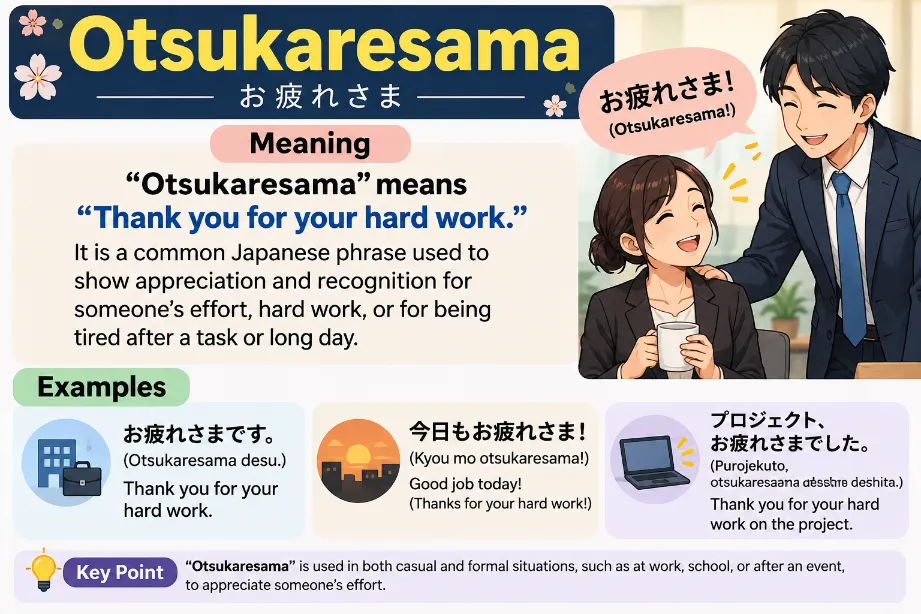
Otsukaresama (お疲れ様) is a Japanese expression used to appreciate another person’s effort, hard work, or contribution. In English, it can mean “thank you for your hard work,” “good job,” or “well done.” The exact meaning depends on the situation and the relationship between the speakers.
Japanese coworkers use this expression as a greeting, a sign of appreciation, or a farewell at the end of a workday. Friends, classmates, and teammates may also use a casual version after completing an activity together.
What Does Otsukaresama Mean in English?
Otsukaresama comes from a Japanese word related to tiredness. Its literal sense acknowledges someone’s fatigue, but its everyday use focuses on appreciating the effort that person has given.
Here are some common English translations:
- Thank you for your hard work: Shows appreciation for someone’s effort.
- Good job: Offers friendly praise after completing a task.
- Well done: Recognizes a successful effort.
- See you later: Can work as a farewell among coworkers.
- Hello: Serves as a workplace greeting in many Japanese offices.
Otsukaresama does not have one fixed English translation. The situation and tone of voice help convey the intended meaning.
Japanese Spelling and Pronunciation
Otsukaresama uses Japanese characters and has several written forms.
| Detail | Information |
|---|---|
| Japanese spelling | お疲れ様 |
| Hiragana | おつかれさま |
| Romaji | Otsukaresama |
| Pronunciation | Oh-tsu-kah-reh-sah-mah |
| Main meaning | Appreciation for someone’s effort |
| Common setting | Workplaces and daily conversations |
The expression relates to tsukareru (疲れる), a Japanese verb meaning “to get tired.” The polite phrase acknowledges the work or effort someone has put into an activity.
Common Forms of Otsukaresama
Japanese speakers use several versions depending on the setting, level of politeness, and relationship between speakers.
| Japanese phrase | Romaji | English meaning |
|---|---|---|
| お疲れ様 | Otsukaresama | Good work; thanks for your effort |
| お疲れ様です | Otsukaresama desu | Thank you for your hard work |
| お疲れ様でした | Otsukaresama deshita | Thank you for your work; good work today |
| お疲れ | Otsukare | Nice job; good work |
| おつ | Otsu | A shortened, casual expression |
Otsukaresama desu suits polite workplace conversations. Otsukaresama deshita commonly acknowledges completed work or an activity. Otsukare and otsu sound more casual, making them suitable for friends and close colleagues.
How to Use Otsukaresama in Daily Life
Otsukaresama has several practical uses in everyday Japanese conversation.
1. Greeting a coworker
Japanese colleagues may greet each other with Otsukaresama desu while passing in the office or starting a conversation.
Example:
A: お疲れ様です。
B: お疲れ様です。
English meaning:
A: Hello, thanks for your hard work.
B: Hello, same to you.
2. Finishing a workday
At the end of a shift, colleagues may exchange Otsukaresama deshita to acknowledge the work they have completed.
Example:
A: 今日もお疲れ様でした。
B: お疲れ様でした。
English meaning:
A: Good work today.
B: Thank you. You too.
3. Appreciating a friend’s effort
After a sports match, study session, or group project, a casual Otsukare can express appreciation.
Example:
お疲れ!
Romaji: Otsukare!
English meaning: Nice work! Good job!
4. Sending a workplace message
Japanese coworkers may start an email or workplace chat with Otsukaresama desu. The expression works as a polite opening before the sender discusses a task, shares information, or asks a question.
Also Check: Okaerinasai Meaning
Otsukaresama vs. Arigatou
Otsukaresama and Arigatou both express positive feelings, but their purposes differ.
| Japanese expression | English meaning | Main purpose |
|---|---|---|
| Otsukaresama | Thanks for your hard work | Acknowledges effort |
| Arigatou | Thank you | Expresses gratitude |
| Ganbatte | Do your best | Offers encouragement |
| Gokurousama | Good work; thanks for your effort | Commonly carries a superior-to-subordinate tone |
For example, say Arigatou after a friend gives you a gift. Use Otsukaresama after that friend finishes a demanding task or completes a shared activity.
Gokurousama requires extra care. It can sound patronizing if directed at a superior, so Otsukaresama desu generally offers a safer option in professional conversation.
Why Otsukaresama Is Important in Japanese Work Culture
Japanese workplace communication uses Otsukaresama as more than a compliment. The expression acknowledges shared effort and helps colleagues maintain polite, friendly relationships.
Its everyday uses range from greeting coworkers in a hallway to closing a meeting or saying goodbye at the end of a shift. A person does not need to finish an exceptional task to receive this greeting.
The phrase also allows speakers to show appreciation without making a formal speech. A short exchange can communicate respect, teamwork, and gratitude naturally.
Common Mistakes to Avoid
Japanese learners can use Otsukaresama more naturally by avoiding a few common errors.
- Translating it literally every time: In ordinary workplace conversations, the phrase usually acknowledges effort rather than physical tiredness.
- Using Otsukare in every situation: The casual form may sound too familiar in formal professional settings.
- Treating it as a universal greeting: It fits shared work or group activities better than every social encounter.
- Confusing it with Arigatou: Arigatou directly expresses thanks, while Otsukaresama acknowledges effort.
- Using Gokurousama with a superior: This expression carries hierarchical associations and may sound inappropriate.
Final Thoughts
Otsukaresama is a useful Japanese expression for showing appreciation, acknowledging hard work, and greeting colleagues. Its meaning changes slightly according to the situation, so a direct word-for-word translation does not always sound natural in English.
For learners, Otsukaresama desu is a practical starting point for polite workplace conversation. Otsukare works better among friends, while Otsukaresama deshita suits the end of a completed task or workday.
What does Otsukaresama mean in English?
Otsukaresama means “thank you for your hard work,” “good job,” or “well done.” It may also function as a greeting or farewell among coworkers.
Is Otsukaresama formal or casual?
Otsukaresama desu is polite and suitable for many workplace exchanges. Otsukare is more casual and works best among friends or close colleagues.
Can I say Otsukaresama to my boss?
Yes. Otsukaresama desu is widely used between coworkers and toward superiors in Japanese workplaces. The exact wording may vary by company and situation.
What does Otsukaresama deshita mean?
Otsukaresama deshita acknowledges someone’s effort after a task or work period has finished. A natural English translation is “Thank you for your hard work today.”
Is Otsukaresama the same as Arigatou?
No. Arigatou means “thank you,” while Otsukaresama focuses on acknowledging effort. Both may suit the same exchange, depending on the speaker’s intention.