“Digitally anonymised” describes information processed so a person cannot readily be identified from the available data. The process removes, changes, masks, or generalises personal identifiers such as names, email addresses, phone numbers, account details, or other identifying information.
The phrase appears across privacy notices, research papers, websites, mobile applications, online forms, analytics systems, and data-management practices. Its main purpose is to reduce the connection between stored information and a particular individual.
What Does Digitally Anonymised Mean?
Digitally anonymised means digital data has undergone a process designed to prevent identification of the person linked to that data.
For example, a company may have a customer record containing:
- Full name
- Email address
- Phone number
- Home address
- Customer ID
- Purchase information
After anonymisation, direct personal identifiers may be removed or altered. The remaining information could show general purchasing patterns without directly revealing the customer’s identity.
A simple example:
| Original data | Anonymised data |
|---|---|
| Ahmed Khan | User 4821 |
| [email protected] | Removed |
| +92 300 1234567 | Removed |
| Lahore | Region: Punjab |
| Age: 31 | Age range: 30–35 |
The exact method depends on the system, data type, and privacy requirements.
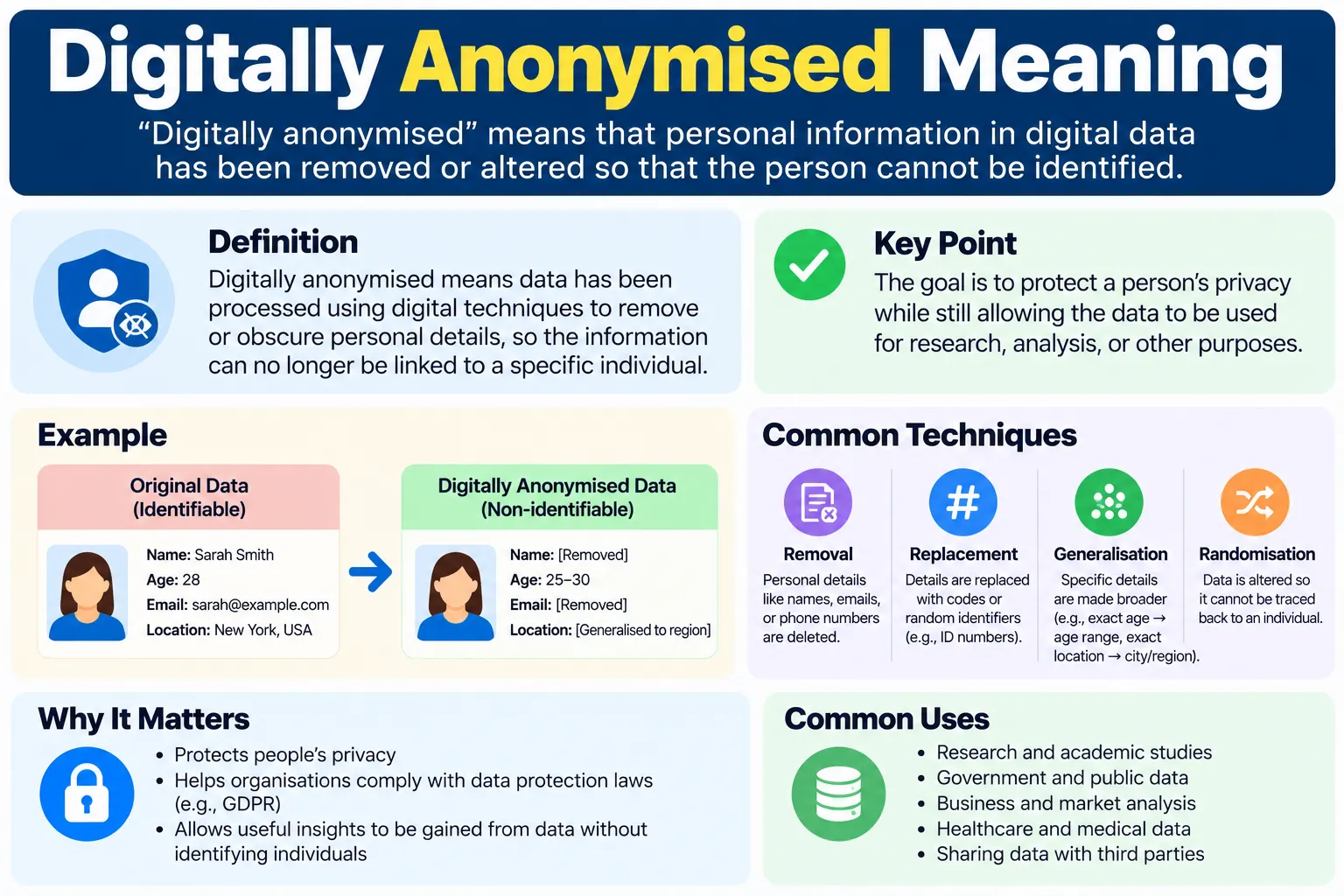
Digitally Anonymised Meaning in Simple Words
In simple terms, digitally anonymised means personal information has been changed so it cannot readily be connected to a particular person.
For example, a website may collect visitor information for statistical analysis. Instead of keeping a visitor’s name, email, or account details beside the activity record, the system may remove those identifiers.
The remaining data can still help with analysis without directly pointing toward one individual.
How Digital Anonymisation Works
Digital anonymisation can use several techniques. The selected method depends on the type of information and the privacy level required.
Common methods include:
- Removing identifiers: Names, email addresses, phone numbers, and account details are deleted.
- Masking: Part of a data field is hidden or replaced.
- Generalisation: Exact values become broader categories, such as changing age 32 to an age range.
- Pseudonymisation: A direct identifier gets replaced with another value, such as a random ID.
- Aggregation: Individual records are combined into broader statistics.
- Data suppression: Certain fields are removed entirely to reduce identification risk.
Digitally Anonymised vs Pseudonymised
These terms can sound similar, yet they describe different privacy approaches.
| Term | Basic meaning | Direct identification |
|---|---|---|
| Digitally anonymised | Data is processed to prevent identification | Designed to prevent identification |
| Pseudonymised | Identifiers are replaced with codes | May remain possible using additional information |
| Encrypted | Data is transformed using encryption | Can be readable with the correct key |
| Masked | Certain characters or fields are hidden | Some original information may remain |
A pseudonymous record can still connect back to a person through a separate lookup system. Proper anonymisation aims to remove that connection.
Example of Digitally Anonymised Data
Suppose an online store wants to study shopping patterns.
The original database might contain:
- Customer name
- Email address
- Exact delivery address
- Purchase history
- Payment information
For statistical analysis, the company may remove direct identifiers and retain information such as:
- Product category
- Purchase month
- Broad geographic area
- Age range
- Order value range
Researchers can then study general purchasing patterns without working directly with personal identifiers.
Why Digital Anonymisation Is Used
Digital anonymisation can reduce privacy risks during data analysis, research, reporting, and system testing.
Common uses include:
- Academic research
- Medical research
- Website analytics
- Customer behaviour analysis
- Software testing
- Business reporting
- Public datasets
- Statistical research
- Machine-learning datasets
- Internal data analysis
It can also help organisations limit exposure of personal information during routine data processing.
Is Digitally Anonymised Data Completely Anonymous?
Not every privacy technique provides the same level of anonymity.
A dataset may appear anonymous yet still contain combinations of information that could identify a person. For example, a rare combination of age, location, occupation, and activity could potentially point toward one individual.
For this reason, privacy specialists examine the entire dataset rather than checking only names and email addresses.
Important considerations include:
- How many identifying fields remain?
- Can separate datasets be combined?
- Are rare characteristics present?
- Can an external database reveal identities?
- Does the data contain precise location details?
- Are unique patterns still visible?
Digital Anonymisation and Online Privacy
The phrase also appears in discussions about online privacy. Websites, applications, advertising systems, and analytics platforms may process information about user activity.
An anonymised dataset might retain general statistics such as:
- Number of visits
- General geographic region
- Device category
- Broad age group
- Page activity
- Session duration
The exact privacy protection depends on the techniques applied and the surrounding data environment.
Digitally Anonymised Data and Personal Information
Personal information can take many forms. Direct identifiers are easy to recognise, yet indirect identifiers can also matter.
Examples of direct identifiers include:
- Full name
- Email address
- Telephone number
- Government identification number
- Account number
Examples of indirect identifiers include:
- Precise location
- Rare occupation
- Exact birth date
- Unique behavioural patterns
- Unusual transaction details
Effective anonymisation considers both types.
Benefits of Digital Anonymisation
| Benefit | Description |
|---|---|
| Privacy protection | Reduces direct links between data and individuals |
| Safer analysis | Allows broader data analysis with less personal exposure |
| Research support | Makes some datasets more suitable for research |
| Reduced data exposure | Limits unnecessary personal details |
| Statistical use | Supports analysis of trends and patterns |
| Testing support | Can provide less sensitive datasets for development work |
Limitations of Digital Anonymisation
Anonymisation does not automatically make every dataset risk-free.
Potential concerns include:
- Data combinations may reveal identities.
- External datasets may provide additional clues.
- Poorly designed anonymisation can leave identifying information.
- Re-identification techniques may work against weak anonymisation.
- More detailed datasets can carry greater privacy risks.
The level of protection depends heavily on the anonymisation method, dataset structure, and information available outside the dataset.
Digitally Anonymised Meaning in Privacy Policies
A privacy policy may use the phrase to explain how an organisation handles information after collection.
For example, a policy might state that certain information is anonymised for analytics. In practical terms, this can mean direct personal identifiers are removed or transformed before the information is used for statistical purposes.
Readers should check the exact wording of the policy because “anonymised,” “de-identified,” and “pseudonymised” can describe different technical processes.
Digitally Anonymised Meaning in Research
Research organisations may use anonymised datasets to study patterns without exposing direct personal identifiers.
A research dataset could contain:
| Field | Possible treatment |
|---|---|
| Name | Removed |
| Removed | |
| Exact address | Removed or generalised |
| Age | Age range |
| Region | Broad geographic area |
| Research result | Retained |
| Study category | Retained |
This structure can support statistical work while reducing direct exposure of personal information.
Final Takeaway
Digitally anonymised meaning refers to digital information processed so personal identity cannot readily be linked to the data. Techniques such as removing identifiers, masking, aggregation, and generalisation can reduce privacy risks.
The term does not simply mean “data with a name removed.” Effective anonymisation considers the full dataset and the possibility that other available information could reveal an identity.
What does digitally anonymised mean?
Digitally anonymised means digital information has been processed to prevent the data from being linked readily to a particular person.
Does anonymised mean the data has been deleted?
No. Anonymised data can still exist and remain useful for analysis. Personal identifiers may have been removed or transformed rather than deleting the entire dataset.
Is pseudonymised the same as anonymised?
No. Pseudonymised data can potentially be connected to an individual through additional information. Anonymisation aims to prevent that connection.
Can anonymised data ever identify someone?
Some datasets may carry re-identification risks, particularly if they contain detailed or rare combinations of information or can be combined with other datasets.
What is the main purpose of digital anonymisation?
The main purpose is to reduce the connection between digital information and identifiable individuals while preserving useful data for analysis, research, reporting, or other legitimate purposes.
