
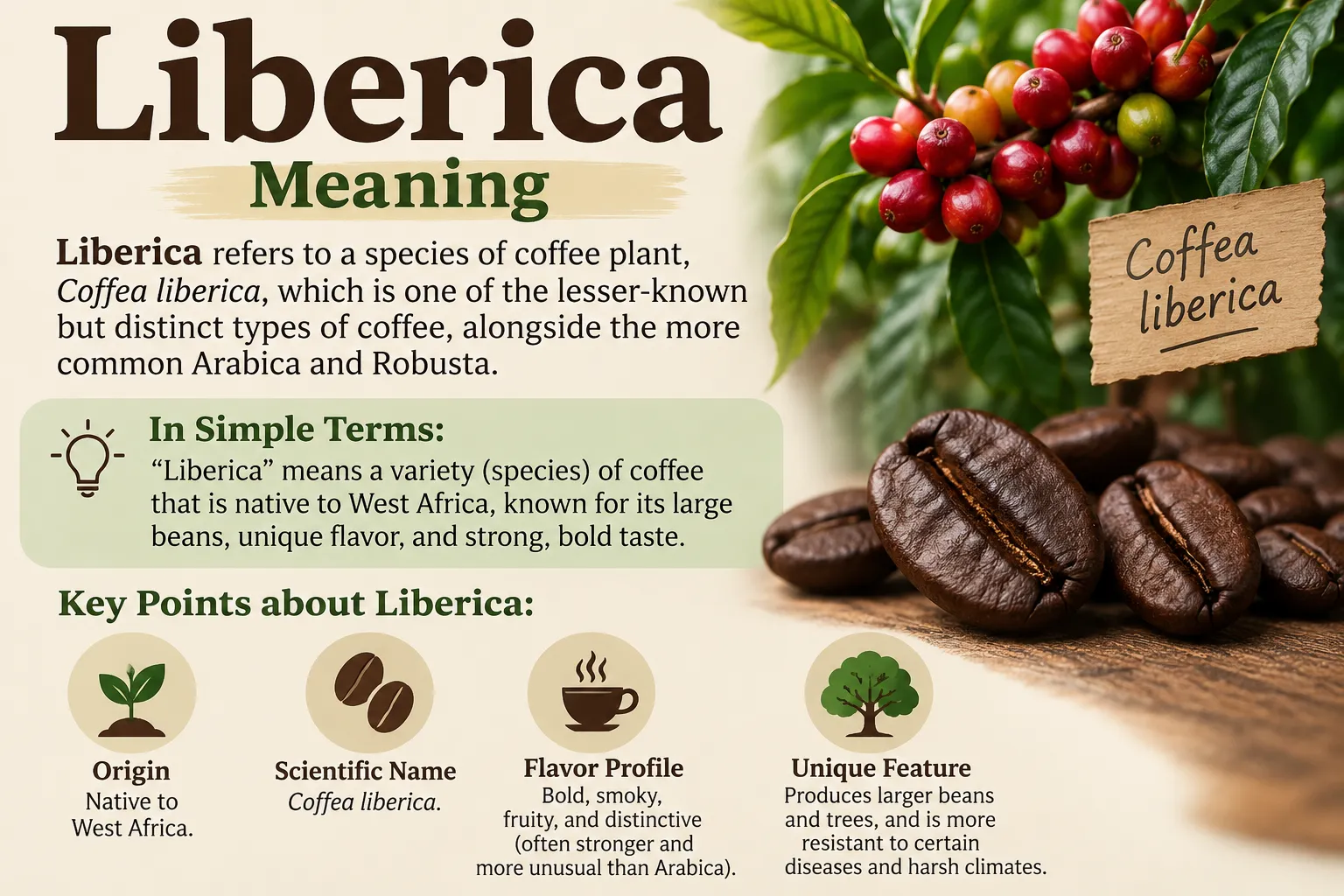
Liberica meaning refers to the identity, origin, and characteristics of Coffea liberica, a coffee species native to western and central Africa. The word “Liberica” comes from Liberia, a country in West Africa closely connected with the early botanical description of this coffee plant.
Liberica coffee has a distinct place in coffee culture because of its large beans, tall trees, unusual fruit shape, and rich aroma. The plant can grow considerably taller than many commercial coffee varieties, making its appearance quite different from the familiar Arabica and Robusta plants.
The term can refer to both the coffee species and the beans produced by that plant. In everyday use, Liberica usually points toward a coffee with a bold sensory profile, large beans, and a strong connection to Southeast Asian coffee traditions.
What Does Liberica Mean?
The simplest Liberica meaning is a coffee species called Coffea liberica. It belongs to the Rubiaceae family and produces coffee cherries that contain the beans used for roasting and brewing.
Liberica has a few traits that make it easy to distinguish from other major coffee species:
- Large coffee cherries and beans
- Tall and sturdy coffee trees
- Broad leaves
- Strong fragrance
- Distinct fruity and woody flavors
- Better tolerance of certain environmental conditions
- Historical roots in Africa
- Strong cultural presence in parts of Southeast Asia
The word also appears in botanical and agricultural discussions, particularly around coffee cultivation, plant genetics, and regional coffee production.
Liberica Coffee Origin
Liberica originated in tropical regions of western and central Africa. Liberia has a special connection with the species, which explains the botanical name Coffea liberica.
During the 19th century, coffee producers faced serious problems caused by coffee diseases. Liberica attracted attention as growers searched for additional coffee species that could survive difficult growing conditions.
The plant later reached several parts of Asia. Farmers in the Philippines, Malaysia, Indonesia, and neighboring areas developed local traditions around Liberica cultivation and preparation.
The Philippines has a particularly strong relationship with Liberica coffee. In local coffee culture, the species is sometimes called kapeng barako, especially in Batangas. The name has become closely tied to strong coffee and regional identity.
Why Is Liberica Coffee Different?
Liberica differs from Arabica and Robusta in several physical and sensory ways. The tree can grow much taller, its leaves can become very broad, and its cherries tend to have a distinctive shape.
The beans also have an unusual appearance. They can look larger and more irregular than standard Arabica beans.
A comparison helps make the differences clearer:
| Feature | Liberica | Arabica | Robusta |
|---|---|---|---|
| Scientific species | Coffea liberica | Coffea arabica | Coffea canephora |
| Bean size | Very large | Medium | Small to medium |
| Tree size | Very tall | Smaller | Medium to tall |
| Flavor profile | Fruity, woody, floral | Sweet, smooth | Strong, bitter, earthy |
| Caffeine | Moderate | Lower | Higher |
| Common growing regions | Africa, Southeast Asia | Many coffee regions | Africa, Asia, Brazil |
| Cherry appearance | Large and distinctive | Smaller | Small and rounded |
These differences make Liberica appealing to people searching for coffee outside the familiar Arabica and Robusta categories.
Liberica Meaning in Coffee Culture
Liberica meaning goes beyond a botanical label. In several regions, the coffee has cultural value tied to farming traditions, family businesses, local markets, and regional food habits.
In the Philippines, kapeng barako has a particularly strong association with Batangas. People have traditionally served the coffee at home, in local eateries, and during social gatherings.
Liberica also has a place in Malaysian coffee culture. Some farmers and specialty coffee producers have worked with Liberica because of its distinctive flavor and heritage.
For many coffee drinkers, Liberica represents something different from mass-market coffee. Its limited production and unusual sensory character can make each cup feel more distinctive.
What Does Liberica Coffee Taste Like?
Liberica coffee can produce a broad range of flavors based on the growing region, processing method, roasting style, and brewing technique.
Many cups feature a combination of:
- Fruity notes
- Floral aromas
- Woody tones
- Smoky hints
- Dark chocolate flavors
- Mild spice
- Ripe fruit characteristics
- A full-bodied mouthfeel
Some Liberica coffees have a strong aroma that becomes noticeable soon after brewing. The flavor may feel heavier than Arabica, yet the cup can also show sweetness and fruit character.
Roasting has a major effect on the final profile. A lighter roast may reveal more floral and fruity notes, while a darker roast can emphasize smoky, woody, and chocolate-like flavors.
Also Check: YT Meaning
Liberica Bean Size and Appearance
One of the easiest ways to identify Liberica is its unusual bean size. Liberica cherries and beans can appear much larger than those associated with Arabica and Robusta.
The beans may have an irregular shape rather than the familiar oval appearance seen in many commercial coffee varieties.
Important physical traits include:
- Large cherries
- Large seeds
- Thick outer fruit
- Broad leaves
- Tall plant structure
- Strong branches
- Deep root systems
The plant’s size creates both opportunities and challenges for farmers. Harvesting mature trees can require more labor, especially in areas without mechanized equipment.
Where Does Liberica Grow?
Liberica originated in Africa, but farmers later introduced it to several tropical regions.
Today, Liberica cultivation has a notable presence in parts of Southeast Asia, particularly:
- Philippines
- Malaysia
- Indonesia
- Thailand
- Certain African regions
The species prefers warm tropical environments. Adequate rainfall, suitable soil, sunlight, and good drainage support healthy growth.
Some farmers also value Liberica because its plant structure can tolerate conditions that may create problems for other coffee species. Still, successful cultivation depends heavily on local climate, soil, farm management, and disease pressure.
Liberica vs Arabica
Liberica and Arabica belong to the same coffee genus, yet they differ greatly in appearance and cup character.
Arabica remains the dominant choice across specialty coffee markets because of its wide range of flavors and established production systems. Liberica has a smaller production base and a more unusual sensory profile.
Liberica trees can reach impressive heights, while Arabica plants remain much more manageable on many farms.
The beans also differ visually. Liberica beans generally appear larger and more irregular, while Arabica beans have a more familiar oval form.
For coffee drinkers, the main distinction may come from flavor. Arabica often brings sweetness, acidity, fruit, and floral notes. Liberica can deliver deeper woody, fruity, smoky, and floral characteristics.
Liberica vs Robusta
Robusta comes from Coffea canephora, while Liberica comes from Coffea liberica. Both species can tolerate challenging tropical environments, but their beans have different characteristics.
Robusta usually has a stronger bitter profile and a higher caffeine level. Liberica can taste more aromatic, fruity, woody, or smoky.
The physical size also creates an obvious difference. Liberica beans can be much larger than Robusta beans.
For espresso, Robusta has a long history of use in blends because of its body and crema contribution. Liberica appears less frequently in mainstream blends but can create a distinctive cup for people seeking unusual coffee flavors.
Liberica Meaning in the Philippines
The Philippines holds a special place in Liberica coffee culture. The species has been cultivated there for generations, and kapeng barako remains associated with Batangas.
The phrase “barako” has strong local associations with strength and boldness. That reputation fits the powerful aroma and flavor found in many traditional preparations.
Liberica farms also form part of the agricultural heritage of several Philippine communities. Small-scale producers continue to cultivate the coffee alongside other crops.
For Filipino coffee drinkers, Liberica can represent regional heritage as much as a beverage.
Liberica Meaning in Malaysia
Malaysia has developed its own Liberica coffee traditions, particularly in Johor. The region has gained attention among coffee producers working with unusual and heritage varieties.
Malaysian Liberica can show fruity, fermented, floral, tropical, and woody flavors depending on processing and roasting.
Some producers use modern processing methods to create cleaner and more complex cups, while traditional methods retain stronger earthy and rustic characteristics.
This range gives Liberica a fascinating position within specialty coffee.
Is Liberica Rare?
Liberica represents a much smaller share of global coffee production than Arabica and Robusta. That limited availability contributes to its reputation as a specialty or heritage coffee.
Several factors explain its smaller production scale:
- Fewer farms cultivate the species.
- Large trees require more space.
- Harvesting can require additional manual work.
- Processing infrastructure may focus on Arabica and Robusta.
- Consumer awareness remains lower in many countries.
- International supply remains comparatively limited.
Its smaller market presence can make authentic Liberica harder to find than mainstream coffee varieties.
Liberica Coffee Benefits
Liberica provides many of the general characteristics associated with coffee, including caffeine and naturally occurring compounds found in coffee beans.
Potential advantages of drinking coffee in moderate amounts may relate to alertness and mental performance, largely due to caffeine.
The exact nutritional profile of a cup depends on roast level, serving size, brewing method, and preparation.
Liberica should therefore be viewed as a coffee choice with a distinctive sensory and cultural profile rather than as a special health product.
How to Brew Liberica Coffee
Liberica works with several brewing methods. The best approach depends on the roast and the flavor profile a drinker prefers.
Popular options include:
- Pour-over
- French press
- Drip coffee
- Espresso
- Moka pot
- Cold brew
A French press can produce a fuller cup that suits the naturally heavy body of some Liberica beans. Pour-over brewing may reveal brighter fruit and floral notes.
Espresso preparation can create a powerful drink with a dense aroma. Cold brewing may soften sharper flavors and emphasize sweetness.
Grinding the beans shortly before brewing can help preserve aroma and flavor.
Liberica Meaning in Modern Coffee
Today, Liberica represents a small but distinctive part of the global coffee landscape. Specialty producers, farmers, roasters, and coffee drinkers have shown increasing interest in heritage coffee species.
Its appeal comes from several qualities at once: unusual beans, tall trees, strong aroma, regional traditions, and flavors that differ from mainstream coffee.
The species also provides an example of coffee diversity. Coffee culture does not rely on a single bean type. Arabica, Robusta, Liberica, and other coffee species each bring their own agricultural and sensory characteristics.
Liberica Meaning: Simple Summary
Liberica meaning points to Coffea liberica, a coffee species with African roots and a strong presence in parts of Southeast Asia.
The most useful points are:
- Liberica is a coffee species.
- The botanical name is Coffea liberica.
- The name connects with Liberia.
- Its beans can be much larger than common coffee beans.
- The trees can grow very tall.
- Its flavor may feature fruity, floral, woody, smoky, or chocolate notes.
- The Philippines has a strong Liberica tradition.
- Malaysia also has an important Liberica coffee culture.
- Liberica represents a smaller portion of global coffee production.
- Its unusual sensory profile makes it appealing to specialty coffee drinkers.
What does Liberica mean in coffee?
Liberica refers to Coffea liberica, a coffee species with large beans, tall trees, and a distinctive flavor profile.
Why is Liberica coffee different?
Its large beans, unusual tree structure, strong aroma, and fruity or woody flavors separate it from Arabica and Robusta.
Where did Liberica coffee originate?
Liberica originated in tropical parts of western and central Africa, with Liberia giving the species its botanical name.
What does Liberica coffee taste like?
The cup can show fruity, floral, woody, smoky, spicy, or chocolate-like notes, depending on farming, processing, roasting, and brewing.
Is Liberica stronger than Arabica?
Liberica can taste stronger and more aromatic, but flavor intensity does not automatically mean higher caffeine. Caffeine varies by bean, roast, and preparation.
Why is Liberica less common?
Its smaller production base, large tree size, labor needs, and limited processing infrastructure contribute to its lower availability.
What is kapeng barako?
Kapeng barako is a traditional Philippine coffee associated with Liberica, especially in Batangas. It has a reputation for a bold aroma and strong taste.