
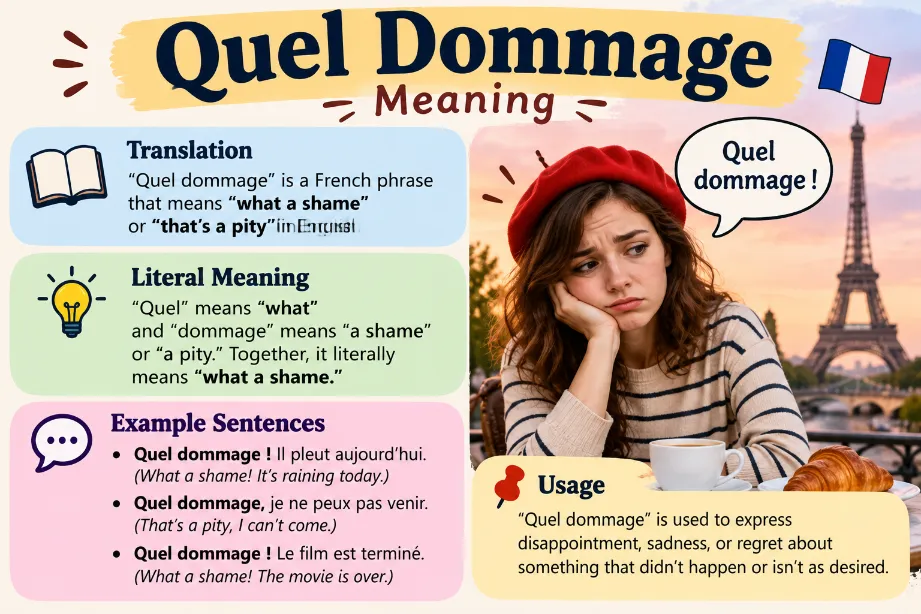
Quel dommage is a French expression that means “what a pity,” “what a shame,” or “that’s too bad” in English. French speakers use this phrase to express regret, disappointment, or sadness about an unfortunate event. It works in casual conversations, polite exchanges, and written messages.
For example, suppose your friend cannot attend your birthday party. You might reply, “Quel dommage !” to show that you feel disappointed about the change of plans.
What Does Quel Dommage Mean in English?
The expression consists of two French words, each contributing to its overall meaning.
| French word | English meaning | Purpose |
|---|---|---|
| Quel | What a | Adds emphasis |
| Dommage | Pity or shame | Expresses regret |
| Quel dommage ! | What a pity! | Shows disappointment |
The best English translation depends on the situation. “What a pity” sounds natural in many conversations, “what a shame” conveys regret, and “that’s too bad” suits everyday speech.
How to Pronounce Quel Dommage
The standard French pronunciation uses the International Phonetic Alphabet transcription /kɛl dɔmaʒ/.
Here are a few tips to help you say the phrase naturally:
- Pronounce quel with a short French vowel sound.
- Connect both words smoothly during speech.
- The final sound in dommage resembles the middle consonant sound in the English word “measure.”
- Avoid adding a separate vowel sound after the final consonant.
Practising the phrase aloud can help you develop a more natural French accent.
Situations for Using Quel Dommage
The phrase quel dommage suits situations involving disappointment, missed opportunities, cancelled plans, or unfortunate news.
Common examples include:
- Cancelled plans: Your friend cannot attend a dinner.
- Missed opportunities: Someone misses an important interview.
- Unexpected news: A concert gets cancelled.
- Personal regret: You cannot visit a place you wanted to see.
- Everyday disappointment: Your favourite shop closes before you arrive.
The phrase expresses regret without sounding excessively dramatic. Your tone of voice helps communicate the strength of your feelings.
Quel Dommage Examples in French and English
These examples show how the phrase works in everyday conversations.
| French expression | English translation |
|---|---|
| Quel dommage ! | What a pity! |
| Quel dommage que tu ne puisses pas venir ! | What a shame you can’t come! |
| Quel dommage, le concert est annulé. | What a pity, the concert is cancelled. |
| Quel dommage de rater ce film ! | What a shame to miss this film! |
| C’est vraiment dommage. | That’s really a shame. |
| Ah, quel dommage ! | Oh, what a pity! |
These sentences demonstrate how the expression can work independently or as part of a longer sentence.
Quel Dommage in Everyday Conversations
Short dialogues offer a practical way to learn the phrase.
Example 1: Cancelled plans
- Marie: Je ne peux pas venir ce soir.
- English: I can’t come tonight.
- Paul: Quel dommage !
- English: What a pity!
Example 2: A missed concert
- Alex: Le concert est complet.
- English: The concert is sold out.
- Sophie: Oh, quel dommage !
- English: Oh, what a shame!
Example 3: A missed train
- Luc: J’ai raté le dernier train.
- English: I missed the last train.
- Emma: C’est vraiment dommage.
- English: That’s really too bad.
Each exchange shows how French speakers express disappointment in a natural, conversational way.
Also Check: Prendre Meaning
Difference Between Quel Dommage and C’est Dommage
Both expressions communicate regret, although their sentence structures differ.
| French phrase | English meaning | Typical use |
|---|---|---|
| Quel dommage ! | What a pity! | An emphatic reaction |
| C’est dommage. | That’s a shame. | A comment about an unfortunate situation |
| C’est vraiment dommage. | That’s really too bad. | Stronger disappointment |
| Dommage ! | Too bad! | A brief reaction |
Use quel dommage to react directly to disappointing news. Use c’est dommage to comment on an unfortunate situation. Both expressions sound natural in French.
Similar French Expressions and Their English Meanings
French has several alternatives for communicating regret or disappointment.
- C’est regrettable — That’s regrettable.
- C’est fâcheux — That’s unfortunate.
- Dommage ! — Too bad!
- Quelle déception ! — What a disappointment!
- C’est triste — That’s sad.
- Quel dommage pour toi ! — What a shame for you!
The best option depends on your intended tone. Quel dommage works as a general expression of regret, while quelle déception places more emphasis on disappointment.
Is Quel Dommage Formal or Informal?
Quel dommage works in both polite and casual conversations. You can use it with friends, relatives, colleagues, or people you have just met.
Here are examples of different tones:
- Polite: Quel dommage que vous ne puissiez pas rester. — What a shame you cannot stay.
- Casual: Ah, quel dommage ! — Ah, what a pity!
- More emphatic: C’est vraiment dommage. — That’s really unfortunate.
The expression suits everyday speech without sounding rude or excessively formal.
Can Quel Dommage Be Used Sarcastically?
Yes. The phrase can carry a sarcastic meaning, depending on the speaker’s tone and the situation.
For example, someone might say “Quel dommage !” after hearing that a person they dislike has missed an event. In such a case, the speaker may be expressing amusement rather than genuine sympathy.
The words alone do not automatically convey sarcasm. Facial expressions, tone of voice, and surrounding conversation help reveal the intended meaning.
Common Mistakes With Quel Dommage
French learners can use this expression more naturally by avoiding a few common errors.
- Using an unnatural translation: “What a pity” and “what a shame” are more natural English equivalents than a strict word-for-word translation.
- Confusing meanings: Dommage can refer to physical damage or harm, but quel dommage expresses regret.
- Using an incorrect sentence structure: French uses quel dommage que before a clause, as in Quel dommage que tu partes ! — What a shame that you’re leaving!
- Ignoring tone: The phrase can communicate mild disappointment or stronger regret, depending on delivery.
Pay attention to the complete sentence to select the most suitable translation.
Final Thoughts
The French phrase quel dommage offers a natural way to express regret or disappointment. Its closest English equivalents are “what a pity,” “what a shame,” and “that’s too bad.” You can use it as a brief reaction to disappointing news or as part of a longer sentence describing an unfortunate situation. Adding this expression to your French vocabulary can make everyday conversations sound more natural.
What does quel dommage mean in English?
It means “what a pity,” “what a shame,” or “that’s too bad.”
Is quel dommage a French expression?
Yes. It is a French exclamation used to express regret or disappointment.
Can I say quel dommage to a friend?
Yes. It sounds natural in casual conversations and also works in polite exchanges.
What is the difference between dommage and quel dommage?
Dommage can mean damage, harm, or pity, depending on its use. Quel dommage ! expresses regret about an unfortunate situation.
Does quel dommage always express sadness?
No. It can communicate mild disappointment, regret, or sarcasm, depending on the situation and the speaker’s tone.
What is a simple alternative to quel dommage?
C’est dommage and dommage ! are useful alternatives. In English, “what a shame” and “too bad” convey similar meanings.