
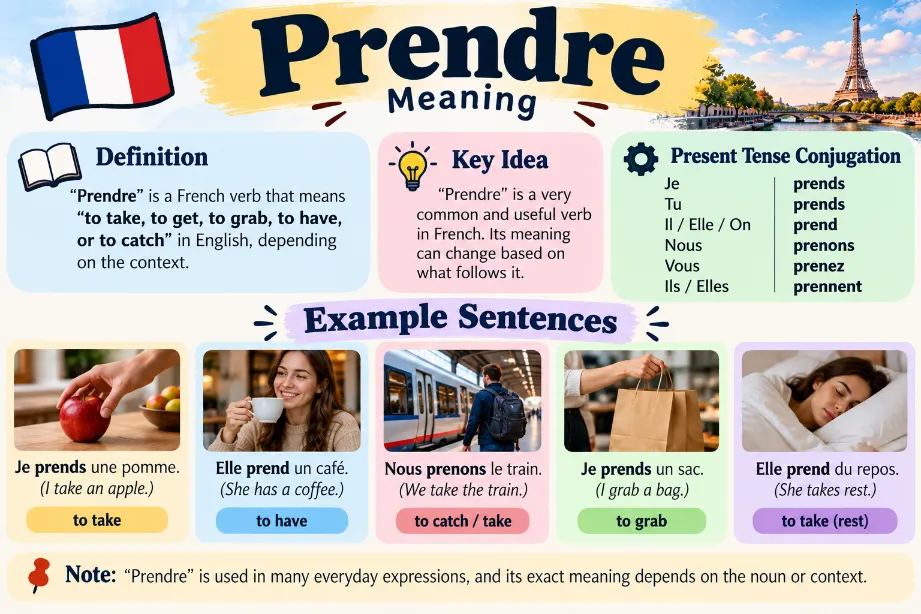
Prendre is a French verb that means “to take” in English. It can also mean “to have,” “to get,” “to catch,” “to pick up,” or “to make,” depending on the sentence. French speakers use this verb in everyday conversations about food, transport, shopping, work, and daily activities.
For example, Je vais prendre un café means “I am going to have a coffee.” In prendre le bus, the same verb means “to take the bus.” The exact English translation depends on the words around it.
Prendre Meaning in English
The French verb prendre describes taking something, selecting an option, receiving something, or performing certain everyday activities. It belongs to the third group of French verbs and has an irregular conjugation, so its forms do not always follow a predictable pattern.
| French expression | English meaning |
|---|---|
| Prendre | To take |
| Prendre un café | To have a coffee |
| Prendre le bus | To take the bus |
| Prendre une décision | To make a decision |
| Prendre une photo | To take a photo |
| Prendre son temps | To take one’s time |
| Prendre froid | To catch a chill |
| Prendre rendez-vous | To make an appointment |
The verb appears in many common French expressions, making it useful for beginners and intermediate learners alike.
How to Use Prendre in French Sentences
French speakers use prendre in several everyday situations. The surrounding words help determine its intended meaning.
| French sentence | English translation |
|---|---|
| Je prends mon sac. | I take my bag. |
| Tu prends du thé. | You have some tea. |
| Elle prend le train. | She takes the train. |
| Nous prenons des photos. | We take photos. |
| Vous prenez une pause. | You take a break. |
| Ils prennent leur déjeuner. | They have their lunch. |
These examples show how one French verb can express several actions in natural English.
Prendre Conjugation in the Present Tense
The present tense of prendre changes according to the subject. Memorizing these forms helps learners form simple sentences correctly.
| French subject | Verb form | English meaning |
|---|---|---|
| Je | prends | I take |
| Tu | prends | You take |
| Il / Elle / On | prend | He / She / One takes |
| Nous | prenons | We take |
| Vous | prenez | You take |
| Ils / Elles | prennent | They take |
Pay attention to the spelling. The singular forms use prends or prend, while nous and vous use prenons and prenez. The third-person plural form has a double n: prennent.
Prendre in the Past Tense
French speakers use the passé composé to describe completed actions in the past. The verb prendre uses the auxiliary verb avoir and the past participle pris.
The basic structure is:
Subject + avoir + pris
Examples:
- J’ai pris un taxi. — I took a taxi.
- Tu as pris mon livre. — You took my book.
- Elle a pris un café. — She had a coffee.
- Nous avons pris le train. — We took the train.
- Ils ont pris des photos. — They took photos.
Notice that pris remains the same in these examples because the verb takes avoir and the direct object does not precede it.
Common French Expressions With Prendre
Several French expressions use prendre in ways that may differ from a direct English translation.
| Expression | Meaning in English |
|---|---|
| Prendre soin de | To take care of |
| Prendre la parole | To speak or take the floor |
| Prendre une douche | To take a shower |
| Prendre des notes | To take notes |
| Prendre une décision | To make a decision |
| Prendre son temps | To take one’s time |
| Prendre rendez-vous | To make an appointment |
| Prendre en compte | To take into account |
| Prendre place | To take a seat |
| Prendre la fuite | To flee or run away |
Learning these expressions helps you sound more natural in conversations, emails, and written French.
Difference Between Prendre and Apprendre
Prendre and apprendre share a similar spelling, but their meanings differ.
| French verb | English meaning | Example |
|---|---|---|
| Prendre | To take | Je prends un livre. — I take a book. |
| Apprendre | To learn | J’apprends le français. — I learn French. |
The verb apprendre can also mean “to teach” in certain constructions, such as apprendre quelque chose à quelqu’un (to teach someone something). The sentence determines the correct translation.
Also Check: ステッカー Meaning Tiktok
Difference Between Prendre and Comprendre
Comprendre means “to understand,” while prendre generally means “to take” or expresses an action through a fixed phrase.
- Je prends le bus. — I take the bus.
- Je comprends la question. — I understand the question.
Both verbs follow related conjugation patterns, making prendre a useful starting point for learning other French verbs.
Tips for Learning Prendre
Use these practical methods to remember the verb and its different forms:
- Memorize the six present-tense forms first.
- Practice common expressions such as prendre un café and prendre le bus.
- Write short sentences about your daily routine.
- Learn the past participle pris alongside the auxiliary verb avoir.
- Read French dialogues to see how native speakers use the verb.
- Practice related verbs such as apprendre, comprendre, and reprendre.
Final Thoughts
Prendre is a useful French verb with a basic meaning of “to take” and several additional meanings in everyday expressions. From ordering coffee to catching a train or making an appointment, it appears in a wide range of common situations. Learning its conjugation and practicing familiar phrases can help French learners use it accurately in speech and writing.
What does prendre mean in English?
Prendre primarily means “to take.” Depending on the expression, it can also mean “to have,” “to catch,” “to get,” or “to make.”
Is prendre a regular or irregular French verb?
Prendre is an irregular verb in the third group of French verbs. Its conjugation changes across different subjects and tenses.
What does je prends mean?
Je prends means “I take.” In a suitable sentence, it can also mean “I have” or “I am taking.”
What does prendre un café mean?
Prendre un café means “to have a coffee” or “to drink a coffee” in English.
What is the past tense of prendre?
The past participle is pris. In the passé composé, French speakers use forms such as j’ai pris (I took), tu as pris (you took), and nous avons pris (we took).
How can beginners remember prendre?
Start with the present-tense conjugation, learn everyday expressions, and practice the verb in short sentences. Repeated use makes its irregular forms easier to recall.