
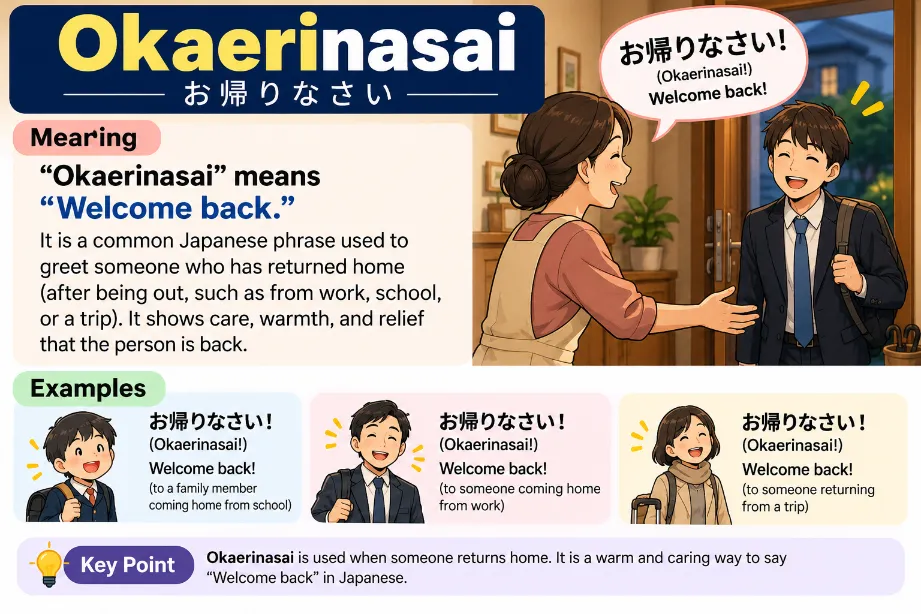
Okaerinasai meaning in Japanese is “welcome home” or “welcome back.” Japanese speakers use this warm expression to greet someone returning home after work, school, a trip, or an outing. It conveys kindness, familiarity, and comfort, making it a common phrase in Japanese households, anime, films, and everyday conversations.
The expression refers to returning to a familiar place. Family members, friends, and housemates may say okaerinasai to greet someone arriving back.
What Does Okaerinasai Mean in English?
Okaerinasai (おかえりなさい) translates into English as “welcome home” or “welcome back.” The exact wording depends on the situation.
| Japanese phrase | English meaning | Common situation |
|---|---|---|
| Okaerinasai (おかえりなさい) | Welcome home | Greeting someone returning home |
| Okaeri (おかえり) | Welcome back | Casual greeting among family and friends |
| Tadaima (ただいま) | I’m home | Said by the person returning |
| Okaerinasaimase (おかえりなさいませ) | Welcome back, in a very polite form | Formal or service-related settings |
The phrase offers more than a simple greeting. It gives the returning person a feeling of being welcomed by someone familiar.
Okaerinasai in Japanese Characters
The Japanese spelling of okaerinasai is おかえりなさい. Japanese speakers write it in hiragana, one of Japan’s main writing systems.
Here is the phrase divided into parts:
- お (o): A polite prefix that adds warmth and respect.
- かえり (kaeri): Relates to returning or coming back.
- なさい (nasai): Adds a polite, conventional form to the expression.
The phrase relates to the Japanese verb kaeru (帰る), which means “to return” or “to go home.” In everyday speech, the complete expression functions as a familiar greeting rather than a literal instruction.
How to Pronounce Okaerinasai
Okaerinasai sounds approximately like oh-kah-eh-ree-nah-sigh.
Break the pronunciation into five parts:
- O — oh
- Ka — kah
- E — eh
- Ri — ree
- Nasai — nah-sigh
Say the syllables smoothly, without placing heavy stress on one part. Japanese pronunciation relies on a relatively even rhythm, so avoid making the final syllable excessively strong.
How to Use Okaerinasai in Daily Conversation
Japanese speakers use okaerinasai to welcome someone who has returned to a familiar place. The phrase fits many ordinary situations.
Examples include:
- A parent greeting a child returning from school.
- A spouse welcoming their partner home after work.
- A family member greeting someone returning from a long journey.
- A housemate welcoming another resident after an outing.
The phrase usually follows tadaima, meaning “I’m home.”
Example conversation:
Person A: Tadaima! (ただいま!)
Person B: Okaerinasai! (おかえりなさい!)
English translation:
Person A: I’m home!
Person B: Welcome home!
This exchange forms a familiar part of everyday Japanese home life.
Difference Between Okaerinasai and Okaeri
Both expressions mean “welcome back,” but they differ in politeness and tone.
| Phrase | Tone | Best use |
|---|---|---|
| Okaerinasai (おかえりなさい) | Polite and warm | Family settings and respectful conversations |
| Okaeri (おかえり) | Casual and friendly | Close friends, siblings, and family members |
| Okaerinasaimase (おかえりなさいませ) | Extra polite | Formal greetings and certain hospitality settings |
Okaeri works well among people who feel comfortable with each other. Okaerinasai offers a more polite alternative. Both expressions greet someone returning from outside.
Okaerinasai Meaning in Anime
Anime fans hear okaerinasai in scenes involving family reunions, school life, romantic relationships, and characters returning home after a long absence.
The phrase can create a warm or emotional moment, especially after a character has spent a long time away from loved ones. A simple “welcome home” may communicate relief, affection, or happiness at seeing someone again.
Common anime situations featuring the expression include:
- A mother greeting her child after school.
- A romantic partner welcoming someone home.
- Friends greeting a character returning after a journey.
- A reunion after a difficult separation.
The emotional tone depends on the characters, their relationship, and the scene. The Japanese phrase itself remains an ordinary greeting.
Is Okaerinasai Romantic?
Okaerinasai can sound affectionate in a romantic scene, but it does not automatically express romantic love. Family members, friends, and housemates also use it.
For example, a girlfriend might greet her boyfriend with okaerinasai after he returns home. The same words could also pass between a parent and child. Their relationship and manner of speaking give the greeting its emotional tone.
Also Check: Sugoi Dekai Meaning
How to Reply to Okaerinasai
You generally do not need a special response to okaerinasai. A smile, a simple thank-you, or a short greeting can work.
Here are some useful Japanese expressions:
- Arigatou (ありがとう): Thank you.
- Tadaima (ただいま): I’m home. This usually comes before the other person says okaerinasai.
- Okaeri (おかえり): Welcome back. This is another version of the greeting rather than a standard reply to it.
A natural exchange at home follows this pattern:
- Person returning: Tadaima! — “I’m home!”
- Person at home: Okaerinasai! — “Welcome home!”
- Person returning: Arigatou! — “Thank you!”
Common Mistakes to Avoid
Japanese learners may confuse okaerinasai with other expressions used around the home. Keep these points in mind:
- Do not use okaerinasai to say “I’m home.” Use tadaima for that meaning.
- Do not confuse okaeri with itterasshai, a phrase used to send someone off as they leave.
- Do not assume okaerinasai carries a romantic meaning in every situation.
- Use the casual form with close friends and family, and the more polite form for a respectful tone.
These distinctions make everyday Japanese conversations sound more natural.
Final Thoughts
Okaerinasai (おかえりなさい) is a warm Japanese greeting used to welcome someone back. Its closest English translations are “welcome home” and “welcome back.” The casual form, okaeri, offers a friendlier alternative among close friends and family.
Learning this expression alongside tadaima makes it easier to follow everyday Japanese conversations and recognize familiar exchanges in anime and Japanese films.
What does okaerinasai mean in English?
Okaerinasai means “welcome home” or “welcome back” in English. Japanese speakers use it to greet someone returning from outside.
What does okaerinasai mean in anime?
In anime, it usually means “welcome home.” A scene may give it a warm, loving, or emotional tone, depending on the characters and their relationship.
Is okaerinasai formal or casual?
Okaerinasai is a polite greeting. Okaeri is its more casual counterpart, commonly used among family members and close friends.
What is the difference between tadaima and okaerinasai?
Tadaima means “I’m home” or “I’m back,” while okaerinasai means “welcome home” or “welcome back.” The returning person usually says tadaima first.
Can I say okaerinasai to a friend?
Yes. You can use it to greet a friend returning to a shared home or another familiar place. Okaeri may sound more relaxed between close friends.
Does okaerinasai mean I love you?
No. The direct meaning is “welcome home” or “welcome back.” It can express affection through the situation, but it does not literally mean “I love you.”