
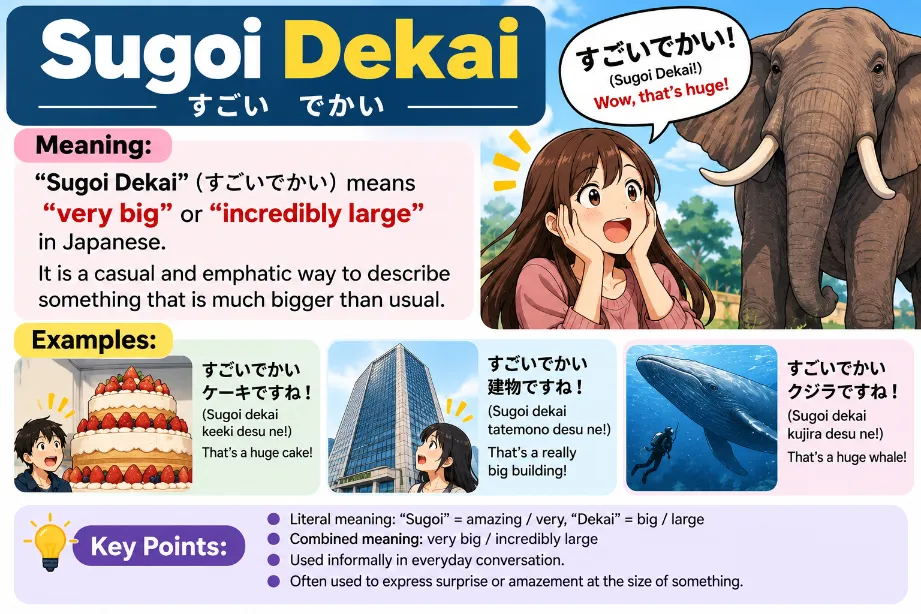
Sugoi Dekai (すごいでかい) is a casual Japanese phrase that means “really huge,” “super big,” or “incredibly large.” Japanese speakers use it to describe something that looks unusually large, impressive, or much bigger than expected.
The phrase combines two Japanese words: sugoi (すごい), which expresses something amazing or extreme, and dekai (でかい), a casual word for big or huge. Together, they add extra emphasis to the size of a person, object, animal, or other thing.
For example, a Japanese speaker might say sugoi dekai! after seeing a massive building, a giant fish, or an enormous serving of food.
Sugoi Dekai Meaning in English
The English translation of Sugoi Dekai depends on the situation, but it usually describes something extremely large.
| Japanese phrase | English meaning |
|---|---|
| Sugoi (すごい) | Amazing, incredible, really |
| Dekai (でかい) | Big, huge, large |
| Sugoi dekai (すごいでかい) | Really huge, super big |
| Sugoku ookii (すごく大きい) | Very big, extremely large |
In everyday conversation, sugoi dekai sounds casual and expressive. English speakers might use phrases such as “That’s massive!” or “That’s so big!” to convey the same feeling.
What Does Sugoi Mean in Japanese?
Sugoi (すごい) is a common Japanese expression that can convey amazement, surprise, admiration, or intensity. Its exact meaning changes with the situation.
Examples include:
- Sugoi! — Amazing!
- Sugoi umai! — Incredibly delicious!
- Sugoi hayai! — Really fast!
- Sugoi dekai! — Extremely big!
Japanese speakers use sugoi in casual conversations, reactions, and informal online messages. It can describe positive qualities, but it can also express surprise at something unusual or overwhelming.
What Does Dekai Mean in Japanese?
Dekai (でかい) is an informal Japanese adjective meaning “big,” “huge,” or “large.” It has a more casual tone than ookii (大きい), the standard Japanese word for big.
For example:
- Kono ie wa dekai. — This house is huge.
- Dekai inu! — What a big dog!
- Sugoi dekai kuruma. — A really huge car.
The word dekai fits relaxed conversations with friends and family. In formal situations, ookii or ōkii (大きい) generally sounds more appropriate.
Sugoi Dekai in Anime and Japanese Pop Culture
Sugoi Dekai became widely familiar among anime fans through the Japanese manga and anime series Uzaki-chan Wants to Hang Out! The character Hana Uzaki wears a white T-shirt with the words “SUGOI DEKAI” printed across the front.
The shirt became a recognizable meme across anime communities, fan art, and social media. Its popularity grew partly because the phrase refers to something very large, while the character’s design makes the wording a humorous visual joke.
The phrase now appears in several online settings:
- Anime memes and fan illustrations
- Japanese language discussions
- Funny captions and reaction posts
- Anime merchandise and character-themed clothing
- Online jokes about unusually large objects or proportions
How to Use Sugoi Dekai in Everyday Conversation
You can use sugoi dekai as an informal reaction to something enormous. The phrase works best in casual speech rather than formal conversations.
Here are a few examples:
| Japanese | English translation |
|---|---|
| Sugoi dekai inu! | What a huge dog! |
| Kono biru, sugoi dekai! | This building is really huge! |
| Sugoi dekai sakana! | What an enormous fish! |
| Waa, sugoi dekai! | Wow, that’s so big! |
These examples illustrate the phrase’s general meaning. In actual conversation, the wording and sentence structure may vary depending on the speaker and situation.
Also Check: Shinzou Wo Sasageyo Meaning
Is Sugoi Dekai Formal or Informal?
Sugoi Dekai has a casual tone. The word dekai sounds more relaxed and conversational than ookii, making it suitable for chats with friends, informal comments, and playful reactions.
For polite conversation, Japanese speakers can use totemo ookii (とても大きい), meaning “very big,” or sugoku ookii (すごく大きい), meaning “extremely large.”
Use these expressions as a guide:
- Casual: Sugoi dekai! — That’s really huge!
- Polite: Totemo ookii desu. — It is very large.
- Casual alternative: Sugoku dekai! — Extremely big!
Sugoi Dekai Meaning on Social Media
On social platforms, sugoi dekai has a meaning beyond ordinary Japanese vocabulary. Anime fans use it as a humorous expression, a meme caption, or a reaction to images featuring exaggerated proportions.
The phrase may refer to a giant creature, a large vehicle, an oversized meal, or a character’s physical features. Its meaning depends on the image, video, or conversation surrounding it.
The meme also has a playful, exaggerated tone. Someone using it online may simply be reacting to something impressive or unusually large rather than making a serious statement.
Final Thoughts
Sugoi Dekai is a casual Japanese expression for something extremely big or huge. The phrase combines sugoi, an expression of intensity or amazement, with dekai, an informal word for large size.
Its popularity among anime fans comes largely from Uzaki-chan Wants to Hang Out! and the memorable T-shirt worn by Hana Uzaki. In everyday Japanese, the expression can describe anything from a giant building to an oversized meal, while online it frequently appears in humorous memes and fan posts.
What does Sugoi Dekai mean in English?
Sugoi Dekai means “really huge,” “super big,” or “incredibly large” in English.
Is Sugoi Dekai a Japanese phrase?
Yes. It combines sugoi (すごい), meaning amazing or extremely, with dekai (でかい), meaning big or huge.
Is Sugoi Dekai an anime meme?
Yes. The phrase became popular among anime fans through Uzaki-chan Wants to Hang Out! and the character Hana Uzaki’s “SUGOI DEKAI” T-shirt.
Can I use Sugoi Dekai in everyday Japanese?
Yes. It works as a casual expression for something extremely large. For polite situations, totemo ookii is a more suitable option.
Does Sugoi Dekai have an adult meaning?
The phrase itself simply means “so big” or “really huge.” In anime memes, it can carry a suggestive meaning because of the character and imagery linked to its popularity.
How do you write Sugoi Dekai in Japanese?
The phrase is commonly written as すごいでかい. Another version uses kanji and katakana: 凄いデカい.