
Kamasutra, also written as Kama Sutra, is an ancient Sanskrit text connected with love, affection, relationships, pleasure, marriage, and social life. The term comes from two Sanskrit words: “Kama”, linked with desire, love, pleasure, and affection, and “Sutra”, meaning a guide, thread, or concise teaching.
The Kamasutra Meaning goes far beyond physical intimacy. The text presents ideas about relationships, attraction, married life, personal conduct, companionship, and the art of living with grace. Its teachings form part of the wider Indian tradition of literature about human desires and social relationships.
Kamasutra Meaning in Simple Words
In simple language, Kamasutra means a guide related to love, desire, pleasure, relationships, and human intimacy.
Many modern readers associate the name mainly with sexual positions. That view represents only one portion of the wider work. The text also discusses courtship, marriage, personal appearance, social manners, emotional connections, and household life.
Some basic points about the term are:
- Kama refers to desire, pleasure, affection, and sensual enjoyment.
- Sutra refers to a concise teaching or guiding principle.
- Kamasutra comes from the Sanskrit literary tradition.
- The work deals with relationships and social conduct as well as intimacy.
- The text has historical and cultural value within ancient Indian literature.
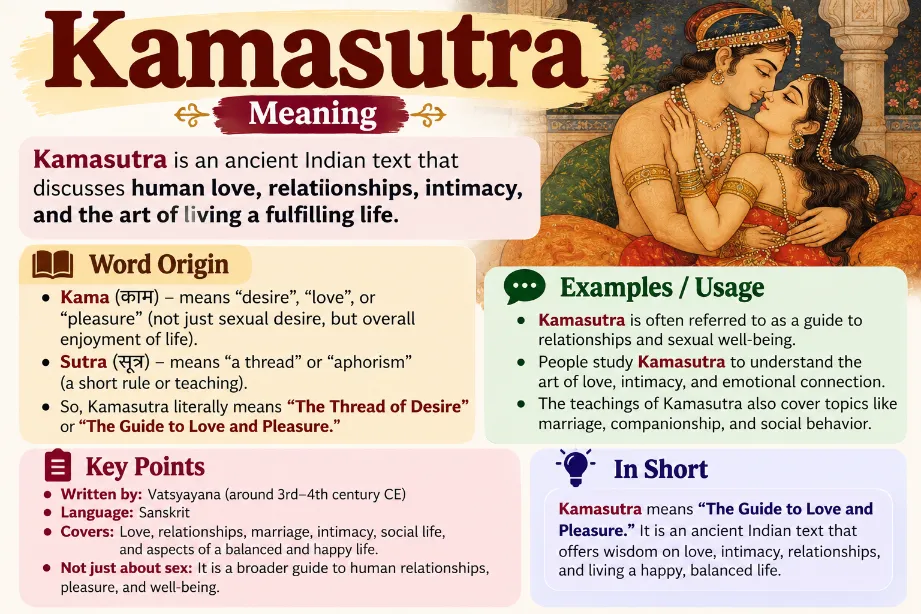
Kamasutra Word Meaning
The word Kamasutra can be divided into two parts:
| Sanskrit Term | General Meaning |
|---|---|
| Kama | Desire, love, pleasure, affection |
| Sutra | Thread, rule, guide, concise teaching |
| Kamasutra | A guide concerning love, desire, pleasure, and relationships |
The word “sutra” appears in several classical Indian works. Sutra-style writing usually presents ideas in a compact form, allowing readers or teachers to expand upon those brief statements through explanation and commentary.
Origin of Kamasutra
The Kamasutra is traditionally attributed to Vatsyayana, a Sanskrit scholar associated with ancient India. Scholars generally place the composition around the early centuries of the Common Era, though the exact date remains debated.
The work belongs to a wider intellectual tradition in which human life received attention through different aims. Classical Indian thought frequently discussed dharma (ethical and social duty), artha (material prosperity), and kama (pleasure and desire), with later traditions also giving attention to moksha (spiritual liberation).
Within this setting, kama had a much broader sense than physical desire alone. It could relate to enjoyment, affection, beauty, music, fragrance, companionship, and pleasurable experiences.
Also Check: Wanton Bridge
Who Wrote the Kamasutra?
Vatsyayana is traditionally regarded as the author of the Kamasutra. Very little reliable biographical information exists about him, so many details about his personal life remain uncertain.
His work presents a structured discussion of love, relationships, marriage, social manners, attraction, and pleasure. The writing follows the compact style associated with Sanskrit sutra literature.
Main Topics in the Kamasutra
The Kamasutra addresses several areas of personal and social life. Its scope makes the work more complex than a modern bedroom manual.
Major themes include:
- Love and attraction
- Courtship and romance
- Marriage and household relationships
- Social manners
- Personal grooming
- Music and artistic activities
- Friendship and companionship
- Emotional and sensual pleasure
- Intimate relationships
- Social behavior
- Advice concerning married life
The work also discusses different forms of companionship and provides observations about social customs from its historical setting.
Kamasutra and Indian Culture
The Kamasutra forms part of a broader Indian literary and philosophical tradition surrounding kama. In this context, pleasure was treated as one aspect of human life rather than as a subject completely separated from society, ethics, family, or personal conduct.
Ancient Indian literature contains many works dealing with love, beauty, marriage, poetry, and desire. The Kamasutra sits within this larger cultural background.
Its historical setting also matters. Modern social ideas differ greatly from those of ancient India, so readers should view the text within the customs and values of its period.
Kamasutra Meaning in Relationships
From a relationship perspective, the text discusses attraction, courtship, affection, companionship, and married life. Some passages focus on social behavior and interpersonal conduct rather than physical intimacy.
The work also gives attention to appearance, manners, conversation, artistic interests, and social interaction. These subjects show that the concept of kama involved several forms of pleasure and human connection.
A modern reader may therefore interpret Kamasutra as a historical discussion of love, intimacy, social relationships, and personal pleasure.
Kamasutra and Marriage
Marriage receives considerable attention in the work. Discussions touch on courtship, household life, affection between partners, and social expectations.
The text also presents customs related to marriage that belong to its historical period. Modern readers may find some of these ideas very different from present-day expectations about relationships, equality, and personal choice.
For that reason, the Kamasutra works best as a historical literary source rather than a direct rulebook for modern relationships.
Kamasutra Meaning and Sexuality
Sexuality forms one part of the Kamasutra. The text discusses physical intimacy in a detailed manner, but its broader subject covers many other areas of human experience.
Its discussion of intimacy sits alongside material about courtship, social conduct, marriage, attraction, and personal refinement. This broader context helps explain why reducing the entire work to sexual positions gives an incomplete picture.
Why Is Kamasutra Famous?
The Kamasutra became widely known outside South Asia through translations and later publications. In modern popular culture, its name frequently appears in discussions about romance and intimacy.
Its reputation also comes from the detailed treatment of human relationships and sensual pleasure. At the same time, its historical background gives it value for readers interested in Sanskrit literature, ancient Indian society, and the history of ideas about love.
Kamasutra Meaning in Modern Language
Today, people may use “Kamasutra” to refer to the ancient Sanskrit text itself or, more generally, to ideas about romantic and intimate relationships inspired by that tradition.
A simple modern definition would be:
Kamasutra means an ancient Sanskrit guide concerning love, desire, pleasure, relationships, courtship, and intimate life.
This definition gives a broader picture than the popular association with physical positions alone.
Important Points About Kamasutra
| Point | Information |
|---|---|
| Original language | Sanskrit |
| Traditional author | Vatsyayana |
| Cultural setting | Ancient India |
| Meaning of Kama | Desire, love, pleasure, affection |
| Meaning of Sutra | Guide, thread, concise teaching |
| Main subjects | Love, relationships, pleasure, marriage, social conduct |
| Literary form | Sutra-style Sanskrit text |
| Historical value | Source for studying ancient ideas about relationships and social life |
Kamasutra Meaning: Final Summary
The Kamasutra Meaning centers on love, desire, pleasure, relationships, and human intimacy. The Sanskrit term combines kama, connected with desire and pleasure, with sutra, referring to a concise guide or teaching.
The work traditionally linked with Vatsyayana covers far more than sexual practices. It discusses courtship, marriage, companionship, appearance, social manners, artistic interests, and intimate relationships. Its place in ancient Indian literature gives it cultural and historical value.
For modern readers, the Kamasutra can be viewed as a classical text about several dimensions of human relationships and pleasure. Its ideas make the most sense through the social and cultural setting of ancient India rather than through modern assumptions alone.