
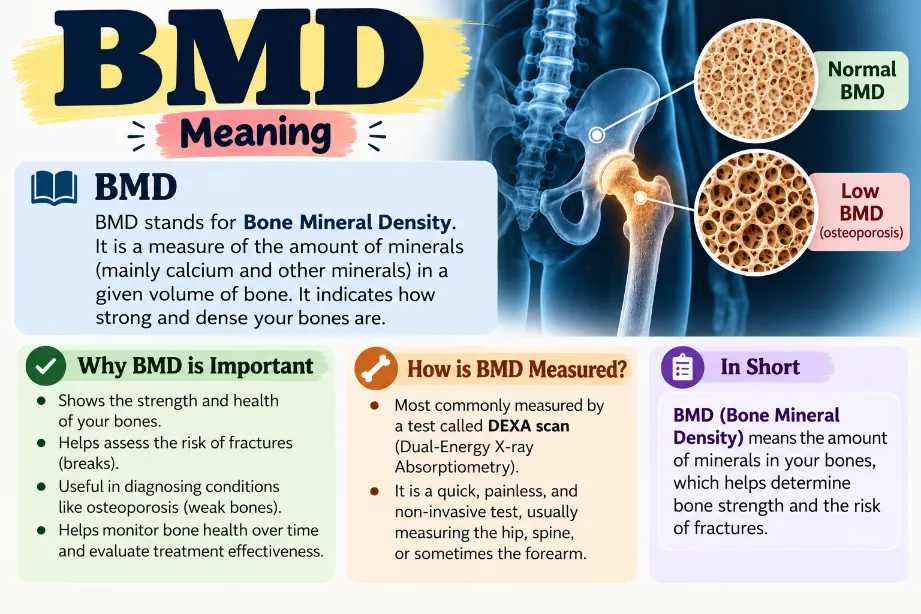
BMD meaning can vary according to the subject, yet the most common use appears in medical discussions. In healthcare, BMD stands for Bone Mineral Density. It describes the amount of minerals, mainly calcium and phosphorus, present within a certain volume of bone. Doctors use BMD measurements to assess bone strength and the likelihood of fractures.
BMD also appears in science, defense, business, and other technical fields. The intended meaning depends on the sentence and subject. For someone searching for the BMD meaning in medical terms, Bone Mineral Density remains the primary definition.
A BMD test can help doctors assess bone health, identify osteoporosis, and monitor changes in bone strength. A common method uses a DXA or DEXA scan, which measures mineral levels in areas such as the hip and spine.
What Does BMD Stand For?
BMD stands for Bone Mineral Density.
Bone tissue contains minerals that help give it strength and structure. Calcium and phosphorus make up much of the mineral content measured during a bone density assessment. A higher mineral density generally relates to stronger bones, while lower density may indicate weaker bones and a higher fracture risk.
Here is a simple breakdown:
| Term | Meaning |
|---|---|
| BMD | Bone Mineral Density |
| Main field | Medicine and healthcare |
| Main purpose | Assessment of bone strength |
| Common test | DXA or DEXA scan |
| Common areas checked | Hip and spine |
| Low BMD | May relate to weaker bones |
| Related condition | Osteoporosis |
The term can appear in medical reports, hospital records, research papers, health websites, and discussions about osteoporosis.
BMD Meaning in Medical Terms
In medical language, BMD refers to the mineral content within bone tissue. Doctors use this measurement as one way to assess bone health.
A BMD test does not simply measure the size of a bone. Instead, it assesses mineral density within a specific area. The result helps medical professionals assess the condition of the skeleton and the possibility of fractures.
Doctors may recommend a bone density test for people who have risk factors for osteoporosis or other conditions that affect bone health. The result can also help a healthcare professional monitor treatment over time.
Common reasons for BMD testing include:
- Checking bone health
- Assessing osteoporosis
- Assessing fracture risk
- Monitoring osteoporosis treatment
- Checking changes in bone density
- Supporting medical decisions about bone health
Also Check: Kamasutra Meaning
What Is a BMD Test?
A BMD test measures mineral density in selected bones. The most widely used method is a DXA scan, also written as DEXA. DXA uses low-dose X-rays to measure mineral levels in areas such as the hip and spine.
The procedure generally takes a short amount of time and does not require surgery. A person lies on a scanning table while the machine measures bone density.
The test can help a doctor assess whether bone density falls within a healthy range or shows signs of bone loss.
BMD and Osteoporosis
Osteoporosis causes bones to become weaker and more likely to break. A low BMD result can support the diagnosis of osteoporosis, particularly alongside other medical information.
Bone density can decrease with age, but several other factors may also affect bone health. Certain medical conditions, medications, lifestyle habits, hormonal changes, and nutritional issues can contribute to reduced bone density.
A healthcare professional reviews the BMD result alongside age, medical history, fracture history, and other relevant information.
What Is a Normal BMD Score?
People frequently search for a single normal BMD number. In practice, doctors usually interpret bone density through scores rather than one universal value.
Two terms appear frequently in bone density reports: T-score and Z-score.
A T-score compares a person’s bone density with the average bone density of a healthy young adult. A Z-score compares the result with people of a similar age and sex.
The interpretation can vary based on age, sex, medical history, and the specific clinical situation. A healthcare professional should explain the result rather than relying on a number alone.
BMD T-Score
The T-score is widely used in osteoporosis assessment. It shows how far a person’s bone density differs from the average measurement of a healthy young adult.
General categories used for adults include:
| T-score range | General interpretation |
|---|---|
| -1.0 or higher | Normal bone density |
| Between -1.0 and -2.5 | Low bone density |
| -2.5 or lower | Osteoporosis range |
These ranges help doctors classify bone density, but a medical professional should assess the full clinical picture before making a diagnosis.
BMD Z-Score
A Z-score compares bone density with people of similar age, sex, and, in some settings, other relevant characteristics.
Doctors may use Z-scores for younger adults, children, and certain other patient groups. The score can help show how a person’s bone density compares with an age-matched reference group.
A low Z-score may prompt further medical assessment, especially alongside other risk factors.
Other BMD Meanings
BMD can have meanings outside healthcare. The correct definition depends on the subject.
Some uses of BMD include:
- Bone Mineral Density — medical and health context
- Ballistic Missile Defense — defense and military context
- Benchmark Dose — toxicology and environmental health research
- Bone Mass Density — a term sometimes used in reference to bone density
The medical definition remains one of the most common uses of BMD. Other definitions can appear in specialized documents and professional discussions.
BMD Meaning in Health Reports
A health report may use BMD beside terms such as DXA, osteoporosis, bone density, T-score, or Z-score. Such wording usually points toward Bone Mineral Density.
For example, a report may discuss:
- BMD measurement
- BMD test results
- BMD of the hip
- BMD of the spine
- BMD T-score
- BMD Z-score
- Low BMD
- Bone density assessment
Reading the surrounding terms can help identify the intended definition.
Why BMD Matters for Bone Health
Bone health plays an important role in mobility and physical independence. Weak bones may fracture more easily, especially after a fall or minor injury. BMD testing gives healthcare professionals a measurable way to assess mineral density and fracture risk.
A BMD result can also help with treatment planning. Doctors may use repeated measurements to assess changes after treatment for osteoporosis.
Bone health also depends on everyday habits. Adequate nutrition, regular physical activity, suitable calcium and vitamin D intake, and avoidance of smoking can support healthy bones. Personal needs vary, so medical advice remains useful for people with health conditions or fracture risks.
BMD Meaning in Simple Words
In simple words, BMD means Bone Mineral Density. It tells doctors how much mineral is present in a certain amount of bone.
You can remember it this way:
BMD = Bone Mineral Density = a measurement used to assess bone strength and fracture risk.
A low BMD result may point toward reduced bone strength, while a higher density generally suggests stronger bone tissue.
Final Thoughts on BMD Meaning
The most common BMD meaning in healthcare is Bone Mineral Density. It describes mineral content within bone and helps medical professionals assess bone health. DXA or DEXA scans provide a common way to measure BMD, especially around the hip and spine. (NIAMS)
BMD can also refer to other technical terms, such as Ballistic Missile Defense or Benchmark Dose. Context provides the best clue about the intended definition.
For medical questions, a BMD result should always receive professional interpretation. A single number does not provide the complete picture of a person’s bone health. Doctors consider the test result together with age, health history, medications, fracture history, and other relevant details.