
Anno Domini meaning comes from Latin and translates to “in the year of the Lord.” The phrase refers to years counted from the traditional birth year of Jesus Christ. It forms the basis of the AD dating system, a calendar convention used across history books, academic writing, religion, museums, and everyday references to dates.
The abbreviation AD appears before a year, such as AD 2026. In modern writing, many people also use CE, meaning Common Era, for the same numbered years.
What Does Anno Domini Mean?
Anno Domini is a Latin expression made from several words:
| Latin term | English meaning |
|---|---|
| Anno | In the year |
| Domini | Of the Lord |
| Anno Domini | In the year of the Lord |
The phrase has a Christian religious origin. Its year numbering system starts from the traditional calculation of Jesus Christ’s birth. The system later became widely used across Europe and eventually spread to many parts of the world.
A date such as AD 500 means the 500th year in the AD era. The system does not use a year zero in the traditional historical calendar.
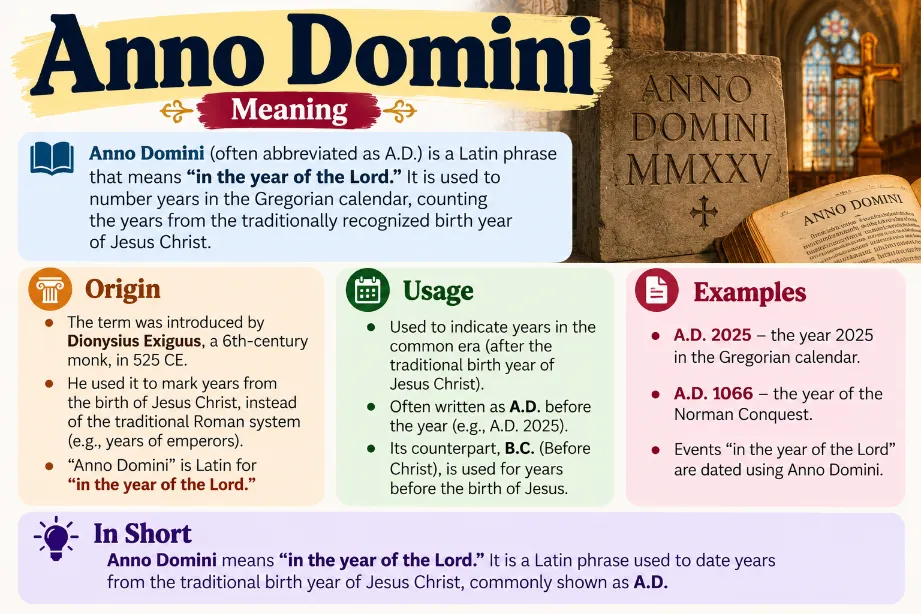
Anno Domini Meaning in Simple Words
In simple terms, Anno Domini means “in the year of the Lord.” It tells readers that a year belongs to the era counted from the traditional birth of Jesus.
For example:
- AD 1 = the first year of the AD era
- AD 100 = the 100th year
- AD 500 = the 500th year
- AD 2026 = the year 2026 in the AD era
Modern historical writing may place AD before or after the number. AD 2026 and 2026 AD convey the same date.
Origin of Anno Domini
The Anno Domini system traces back to Dionysius Exiguus, a Christian monk and scholar who lived during the sixth century. Around AD 525, Dionysius worked on calculations related to the date of Easter.
During this work, he proposed a year-counting system based on the birth of Jesus Christ rather than the reign of a Roman emperor.
Before this system appeared, European writers used several other dating methods. Roman systems could refer to consuls, emperors, or years measured from the foundation of Rome. Dionysius wanted a Christian-based method for identifying years.
His calculation formed the foundation of the AD system used today.
Why Is There No Year Zero?
One unusual feature of the traditional AD system is the absence of year 0.
The sequence moves from:
1 BC → AD 1
There is no traditional AD 0 between them.
This detail can create confusion in historical calculations. Astronomical year numbering uses a different system and does have a year 0, but standard historical dating generally does not.
For example, the difference between 1 BC and AD 1 is one year, not two years.
AD and BC Explained
The AD system works alongside BC, which means Before Christ.
BC years count backward toward the beginning of the AD era.
| Dating term | Meaning | Example |
|---|---|---|
| BC | Before Christ | 500 BC |
| AD | Anno Domini | AD 500 |
| BCE | Before Common Era | 500 BCE |
| CE | Common Era | 500 CE |
The numerical years in BC/BCE and AD/CE match across the same historical dates. The main difference lies in terminology and cultural framing.
For instance:
- 300 BC = 300 BCE
- AD 500 = 500 CE
- AD 1500 = 1500 CE
AD Meaning in History
Historians use AD to identify years after the traditional starting point of the Christian calendar era. It appears in discussions about ancient civilizations, medieval Europe, religious history, archaeology, royal reigns, literature, and major developments in human society.
Examples might look like:
- The Roman Empire reached a major stage during the first centuries AD.
- Medieval European records frequently use AD dates.
- Archaeological reports may assign discoveries to particular centuries AD.
- Historical documents can contain dates such as AD 1066 or AD 1215.
The abbreviation helps readers place a date within a broader chronological system.
Also Check: Matae Meaning: What Does it Mean?
Anno Domini and Christianity
The phrase has a direct connection with Christian tradition because Domini refers to the Lord, meaning Jesus Christ in this context.
The dating method therefore has a religious origin. Over time, its use expanded far beyond religious writing. Governments, scholars, publishers, historians, and international institutions use the same numbered calendar system for practical communication.
A modern person can use an AD date without making a religious statement. In many settings, it simply functions as a conventional calendar reference.
AD vs CE: Are They Different?
AD and CE use the same year numbers.
AD 2026 = 2026 CE
The distinction concerns terminology rather than the numbering itself.
AD comes from Latin and has Christian wording. CE means Common Era and provides a more neutral label for the same calendar numbering.
Similarly:
500 BC = 500 BCE
Many academic publishers and institutions prefer BCE and CE, while religious publications and traditional historical writing may still use BC and AD.
How to Write AD Correctly
There are a few accepted styles for writing AD dates.
Common forms are:
- AD 1066
- 1066 AD
Many traditional style guides place AD before the year, especially in formal historical writing.
For dates before the era:
- 500 BC
- 500 BCE
For modern dates, writers may simply use the year without AD if the context already makes the era clear.
For example, writing 2026 usually gives enough information in modern contexts.
Anno Domini Pronunciation
The Latin phrase Anno Domini is commonly pronounced approximately as:
AN-oh DOM-in-eye
The exact pronunciation can vary based on whether a speaker uses traditional Latin, reconstructed Latin, or an English-language pronunciation.
The abbreviation AD is normally pronounced by saying the two letters separately: A-D.
Common Misconceptions About Anno Domini
Several points about Anno Domini can cause confusion.
- AD does not mean “after death.” Some people incorrectly expand it as “After Death.” The actual phrase is Anno Domini.
- AD 0 does not exist in the traditional system.
- AD and CE use the same numbered years.
- Anno Domini does not mean every date has a religious purpose.
- The traditional AD calculation may not match the exact historical birth year of Jesus.
- Dionysius Exiguus introduced the system in the sixth century.
The “after death” explanation is especially common but incorrect. AD refers to the Latin phrase rather than the number of years after Jesus’ death.
Anno Domini in Modern Use
Modern date writing has several conventions. Some publications prefer AD/BC, while others use CE/BCE. Both systems refer to the same sequence of numbered years.
A history textbook may write:
AD 476
Another academic source may write:
476 CE
Both references point to the same year.
The choice usually depends on editorial style, academic tradition, religious context, or the preference of a publication.
Why Anno Domini Still Matters
The phrase remains useful because it helps explain the origin of one of the world’s most widely used year-numbering systems. It connects present-day calendar conventions with medieval European scholarship and Christian chronology.
Learning the Anno Domini meaning also makes historical dates easier to read. Terms such as AD, BC, CE, and BCE appear throughout books, museum descriptions, historical records, academic papers, and educational materials.
A basic grasp of these labels helps readers place dates in the correct chronological order.
Anno Domini Meaning at a Glance
| Point | Information |
|---|---|
| Language | Latin |
| Meaning | In the year of the Lord |
| Abbreviation | AD |
| Religious origin | Christianity |
| Linked scholar | Dionysius Exiguus |
| Approximate introduction | Sixth century |
| Numbering begins | AD 1 |
| Year zero | None in traditional historical dating |
| Modern equivalent | CE |
| Opposite era label | BC / BCE |
The Anno Domini meaning is simple: “in the year of the Lord.” The Latin phrase gave rise to the abbreviation AD and a year-numbering system that became widespread across Europe before reaching global use. Its traditional sequence moves from 1 BC directly to AD 1, with no year zero.
Today, AD and CE represent the same numbered years, while BC and BCE represent the corresponding earlier years. Knowing these terms makes historical dates easier to read and provides useful context for calendars, chronology, and historical writing.
What does Anno Domini mean?
Anno Domini means “in the year of the Lord.” It is a Latin phrase connected with the Christian system of year numbering.
What does AD stand for?
AD stands for Anno Domini.
Does AD mean after death?
No. AD does not mean “after death.” It comes from the Latin phrase Anno Domini.
Who created the AD dating system?
The system was proposed by Dionysius Exiguus, a sixth-century Christian monk and scholar.
Is AD the same as CE?
Yes. AD and CE use the same numbered years. The terminology differs.
Why is there no AD 0?
Traditional historical dating moves directly from 1 BC to AD 1, so it has no year zero.
What is the difference between BC and AD?
BC refers to years before the traditional Christian era, while AD refers to years within the era counted from the traditional birth year of Jesus.
Is Anno Domini still used today?
Yes. AD remains common in historical, religious, educational, and general writing, although CE and BCE are also widely used.