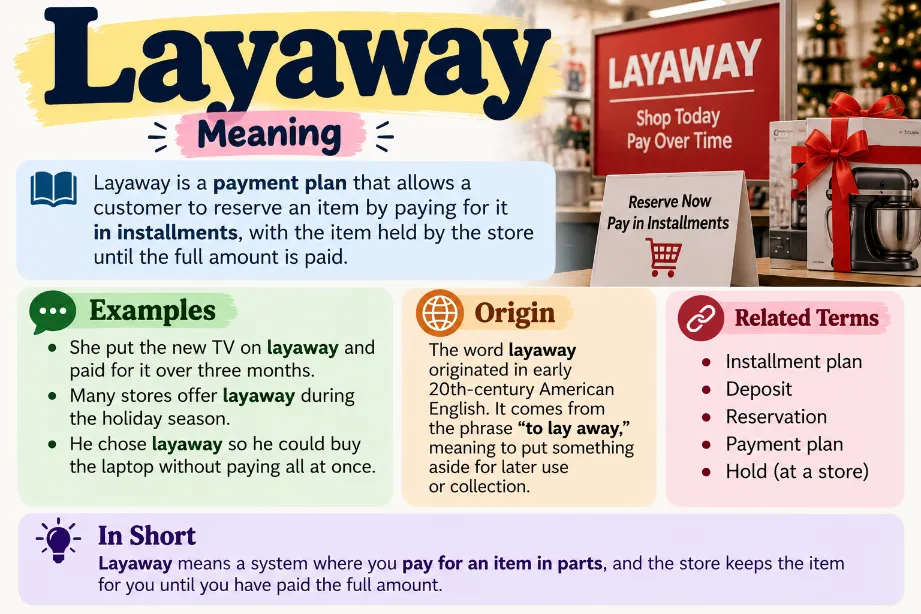
Layaway means a shopping arrangement in which a customer selects an item, pays for it in several installments, and receives the item after paying the full price. The store keeps the product aside during the payment period. This method can help shoppers purchase costly goods without paying the entire amount at once.
The layaway meaning is simple: pay over time, then take the product home after the final payment. It differs from regular credit because the shopper does not receive the product before completing the payment plan.
How Does Layaway Work?
A layaway plan follows a straightforward process. A customer selects a product, agrees to the store’s payment terms, and makes an initial payment. The retailer sets the product aside for that customer.
The shopper then makes scheduled payments until the full balance reaches zero. After the final payment, the store releases the product.
A common layaway process looks like this:
- Select an eligible product.
- Ask the retailer about its layaway plan.
- Pay the required deposit.
- Agree to the payment schedule.
- Make each scheduled payment.
- Finish the remaining balance.
- Collect the purchased item.
The exact rules vary from one retailer to another. Some stores may set a minimum deposit, while others may charge a service fee. Payment periods can also differ.
Layaway Example
Suppose a customer wants to purchase a television priced at $600. The store asks for a $100 deposit and allows the remaining $500 to be paid over five installments.
The shopper pays $100 at the start and then pays $100 each time until the balance reaches zero. After the final $100 payment, the customer receives the television.
| Item | Amount |
|---|---|
| Product price | $600 |
| Initial deposit | $100 |
| Remaining balance | $500 |
| Number of installments | 5 |
| Each installment | $100 |
| Final balance | $0 |
This example shows why layaway can appeal to shoppers who prefer scheduled payments rather than paying a large amount in one transaction.
Also Check: Straggot Meaning
Layaway vs. Credit
Layaway and credit both allow shoppers to spread payments, but they work in different ways.
With credit, a customer usually receives the product at the time of purchase and repays the lender or card provider later. Interest may apply, depending on the credit arrangement.
With layaway, the store keeps the product until the customer pays the entire amount. The customer does not usually borrow money to complete the purchase.
| Feature | Layaway | Credit |
|---|---|---|
| Product received | After full payment | Usually at purchase |
| Borrowed money | No | Usually yes |
| Interest | Usually no interest | May apply |
| Initial payment | Usually required | Depends on lender |
| Payment schedule | Set by retailer | Set by lender or card issuer |
| Ownership before final payment | Generally no | Usually yes, subject to credit terms |
The better option depends on the shopper’s budget, payment habits, and the terms offered by the retailer or lender.
Why Do People Use Layaway?
Layaway can suit shoppers who want to plan a purchase without using a credit card. It gives them a defined payment target and a fixed product price under the store’s agreement.
Common reasons for using layaway include:
- Avoiding credit card debt.
- Spreading a large purchase across several payments.
- Securing a desired item before it sells out.
- Keeping spending within a planned budget.
- Avoiding interest linked to some credit products.
- Purchasing seasonal gifts ahead of time.
- Saving for a costly household product.
For some shoppers, the biggest advantage comes from having a clear payment goal. The product remains reserved, while the customer works toward the final balance.
What Can You Buy With Layaway?
Retailers set their own rules about eligible products. Depending on the store, shoppers may find layaway plans for:
- Furniture
- Electronics
- Appliances
- Jewelry
- Musical instruments
- Toys
- Clothing
- Seasonal merchandise
- Large household products
A retailer may restrict certain products from its layaway program. The customer should check the store’s terms before making the first payment.
Advantages of Layaway
Layaway can provide several practical benefits for budget-conscious shoppers.
No traditional borrowing: A standard layaway plan does not require a loan. The shopper pays the retailer directly according to the agreed schedule.
Budget control: A fixed payment schedule can make a large purchase easier to manage.
No immediate full payment: The customer does not need the complete purchase price on day one.
Product reservation: The store generally sets the chosen product aside during the payment period.
Less reliance on credit cards: People who prefer cash-based budgeting can use layaway without adding a new credit card balance.
Predictable payments: The agreement normally sets the amount and frequency of each payment.
Disadvantages of Layaway
Layaway also has limitations. A shopper should read the store’s policy before making a deposit.
Possible disadvantages include:
- Service or cancellation fees.
- Refund restrictions.
- Missed-payment penalties.
- A limited payment period.
- The product remaining unavailable for personal use until final payment.
- Possible loss of some fees after cancellation.
- Fewer participating retailers than in the past.
A customer should pay special attention to cancellation rules. Some stores may refund the money paid toward the product but keep a service fee or cancellation charge.
Layaway Fees and Payment Terms
Layaway does not automatically mean that every purchase will be free of extra charges. Retailers can set their own policies.
A plan may have:
- A minimum deposit.
- A service fee.
- A cancellation fee.
- A set number of payments.
- A final payment deadline.
- Specific rules for missed payments.
Before signing up, check the total amount you will pay rather than looking only at the installment amount.
For example, a $500 product may appear simple with five $100 payments. A separate $20 service fee would make the actual cost $520. The fee structure matters because it changes the final amount.
What Happens If You Miss a Layaway Payment?
The result depends on the retailer’s terms. Some stores may provide a grace period, while others may cancel the plan after a missed payment.
Possible outcomes can include:
- A reminder or grace period.
- A late fee.
- A revised payment date.
- Cancellation of the plan.
- Refund of part of the money paid.
- Retention of a service or cancellation fee.
Read the payment agreement before starting the plan. A small missed payment can have different consequences at different stores.
What Happens After the Final Payment?
After the shopper pays the complete balance, the retailer confirms that the account has been fully paid. The customer can then collect the product according to the store’s collection procedure.
Some retailers may require:
- Proof of payment.
- The original layaway receipt.
- Identification.
- A confirmation number.
- Collection within a specific period.
Keeping receipts and payment records can make the final collection process easier.
Layaway for Holiday Shopping
Layaway has historically been useful for shoppers preparing for expensive holiday purchases. Instead of paying for several gifts at once, a customer can reserve products and make payments over a set period.
This approach can help a household spread spending across several weeks or months. It can also reduce the temptation to place a large holiday purchase on a credit card.
Still, shoppers should check cancellation policies and payment deadlines before starting a seasonal plan.
Is Layaway Better Than Using a Credit Card?
There is no single answer for every shopper. Layaway may suit someone who wants to avoid borrowing and can wait for the product. A credit card may suit someone who needs the item immediately and has a repayment plan.
Consider these points:
- Need the item immediately: Credit may be more practical.
- Want to avoid borrowing: Layaway may suit you better.
- Need a fixed payment schedule: Layaway can provide structure.
- Want rewards or card benefits: A credit card may provide those features.
- Concerned about interest: Check the card’s terms carefully.
- Concerned about fees: Review the layaway agreement before paying.
The best choice depends on the total cost, payment terms, and personal budget.
Layaway Meaning in Simple Words
In simple terms, layaway means paying for a product over time before taking it home. The retailer reserves the item, the customer makes scheduled payments, and the product becomes available after the full balance is paid.
It can be a useful shopping method for people who prefer planned payments and want to avoid traditional borrowing.
Final Thoughts on Layaway Meaning
The layaway meaning centers on paying for a product before taking possession of it. A shopper selects an eligible item, pays a deposit, follows the store’s installment schedule, and collects the product after the balance reaches zero.
Layaway can suit people who want a structured way to manage a large purchase without relying on traditional credit. Still, fees, deadlines, refund rules, and cancellation policies vary by retailer. Reading the full agreement before making a deposit can help shoppers avoid surprises and choose a payment method that fits their budget.
What does layaway mean?
Layaway means reserving a product at a store and paying for it through scheduled installments before receiving it.
Do you receive the product right away?
No. Under a standard layaway plan, the retailer keeps the product until the customer completes payment.
Does layaway charge interest?
Traditional layaway generally does not charge loan-style interest, though a retailer may charge service or cancellation fees.
Can you cancel a layaway plan?
Many retailers permit cancellation, but the refund and fee rules depend on the store’s agreement.
Is layaway the same as financing?
No. Financing generally gives the customer the product before full repayment, while layaway usually requires full payment before collection.
Can layaway help with budgeting?
Yes. A fixed payment schedule can help shoppers divide a large purchase into smaller planned payments.